Product Review- Aminopure Newfield Nutrition


In the early part of my season I was suffering from colds every time I increased my mileage over 300 miles for the week.  I was so frustrated because each cold meant at least a week off the bike.   I even missed an early season event, the Hell’s Gate Hundred.  Here is a post I made in between the Hell’s Gate Hundred and the Mount Laguna Bicycle Classic.   I had heard of using L-Glutamine as an immune booster but as you know from reading my blog I’m a skeptic 😉

In late May, I began using Aminopure, which is 100% USP Grade (United States Pharmacopeia) L-Glutamine.  I began with the prescribed amount of 5g after a hard ride.  I increased the dosage to 10g after a 3-4 hour hard ride.  On my longer rides 6-10 hours, I would take 10g when I first got off the bike and then another 10g before I went to sleep.

I find it interesting that people outside of the cycling world are aware of the benefits of L-Glutamine supplementation.  The other day I had a gentlemen say to me, “Oh you guys carry L-Glutamine?  Hmm…I give that to my patients in the ICU.”  I responded, “Really?”  He then said, “Yes I give my patients 30 grams a day.”

My experience with Aminopure has been positive and rewarding.  It’s very rewarding to not miss training days because you’re sick.  My good health has been a constant I can count on even when I’ve been training hard, stressed from work, or short on the proper amount of sleep.  I haven’t had a cold since I began using Aminopure regularly in spite of the harder and longer training rides I’ve done compared to those in the early season.  I recommend taking Aminopure as part of your recovery process.  I think you will find you will recover better and be able to train just as hard if not harder on consecutive days.

More information on Glutamine:

Review of Glutamine
Let’s start with a brief review of glutamine.  All body protein is made up of amino acids and glutamine is the most plentiful free amino acid in the body.  Its unique structure and ready availability makes it a vital nutrient for optimal functioning of all organs and organ systems in the body.  Glutamine works by providing extra carbon and nitrogen to organs in need.

The specific systems that depend on glutamine include the:

  • Blood system including the immune cells and the red blood cells
  • Digestive system including the intestines
  • Liver
  • Kidney
  • Brain
  • Musculoskeletal
  • Endocrine glands

Production and Decline of Glutamine in the Body
Although all cells have the potential to make glutamine, it is made primarily in skeletal muscle, followed by the lungs and brain.  With most illnesses and under conditions of stress, such as over-training in athletes, glutamine levels in the blood decrease.  This decline could be due to an increase in the need for glutamine by organs or it could be that skeletal muscle cannot manufacture it rapidly enough to fulfill the demand.  Whatever the reason, there is a deficiency of glutamine in the body and that is the reason for supplementation with glutamine.

Below is a partial list of health conditions or illnesses where glutamine supplementation has been shown to have benefit:

  • Reduced side effects of chemotherapy including lessening of nerve damage to the hands and feet and decreases of mouth sores and diarrhea
  • Improved regulation of the immune system
  • Decreased infection rates
  • Restored muscle mass
  • Improved outcome following surgery, including fewer infections and deaths
  • Prevented HIV wasting
  • Reduced diarrhea
  • Increased nutrient absorption with short bowel
  • Enhanced recovery following athletic over-training
  • Improved blood sugar control in critically ill patients

Recent studies also suggest that glutamine may be useful for people who have heart conditions and individuals who are overweight.  In follow-up issues of this column, I will discuss all of these topics in more detail

Source

Newfield Nutrition Corporation is a new and innovative company that was started and is operated by a group of physician scientists who believe that rational nutritional supplementation can play a vital role in preventive and restorative medicine

Facebook Fan Page


I have created a Facebook Fan Page at the behest of one of my new sponsors.  As I thought about it I thought Duh! why hadn’t I done this a long time ago. It was one of those “I should’ve had a V8” moments. Anyway, I created my fan page and I think it’s going to be great to have my personal life posts separate from my cycling specific posts. Since many of my friends are cycling friends they won’t be impacted as much. But for my friends that I’ve met in my other walks of my life it will be a relief to not see my silly little power charts and graphs 🙂

Please go to my Fan Page and “Like” it.

I tried to find the old “I should’ve had a V8” commercials on youtube.com from my childhood but I guess they are too old. So enjoy “Could’ve had a V8” instead.

Back to Back Centuries


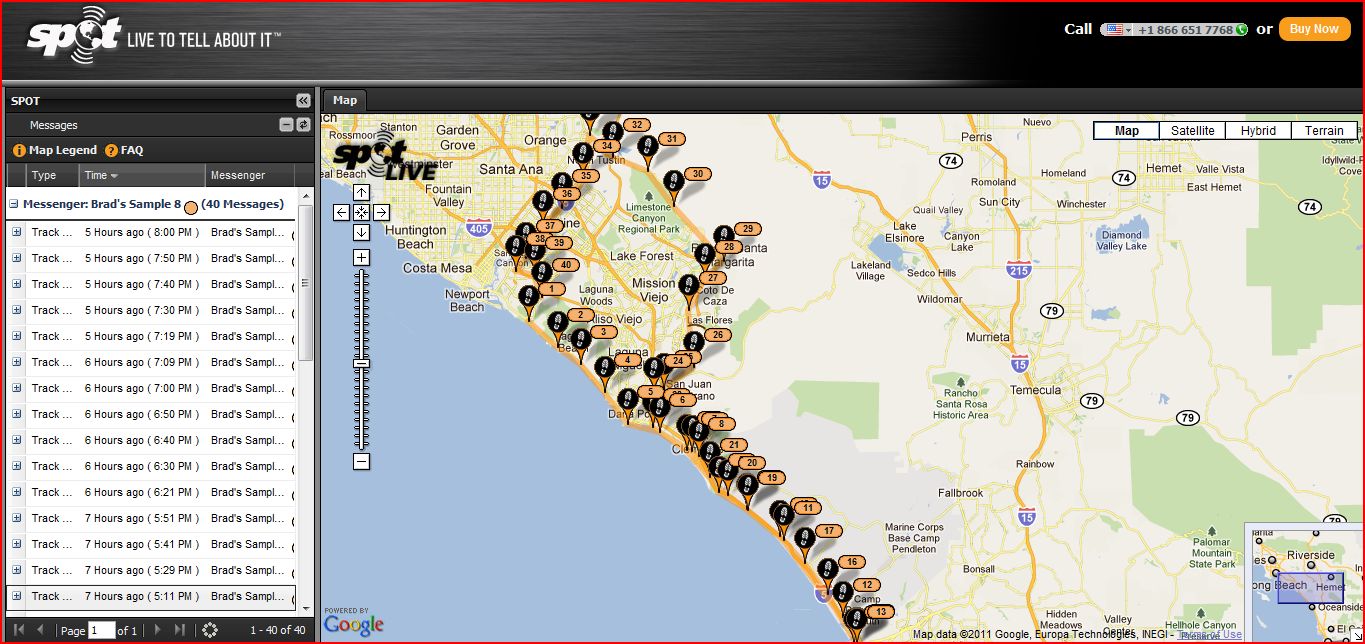
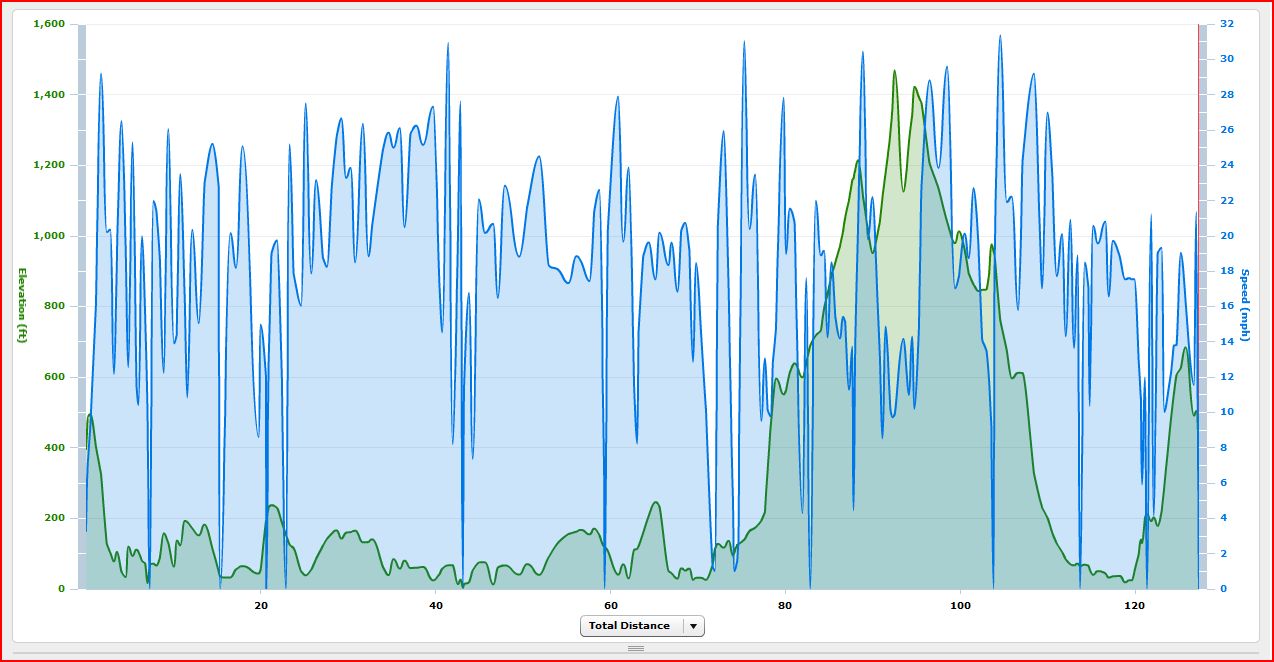
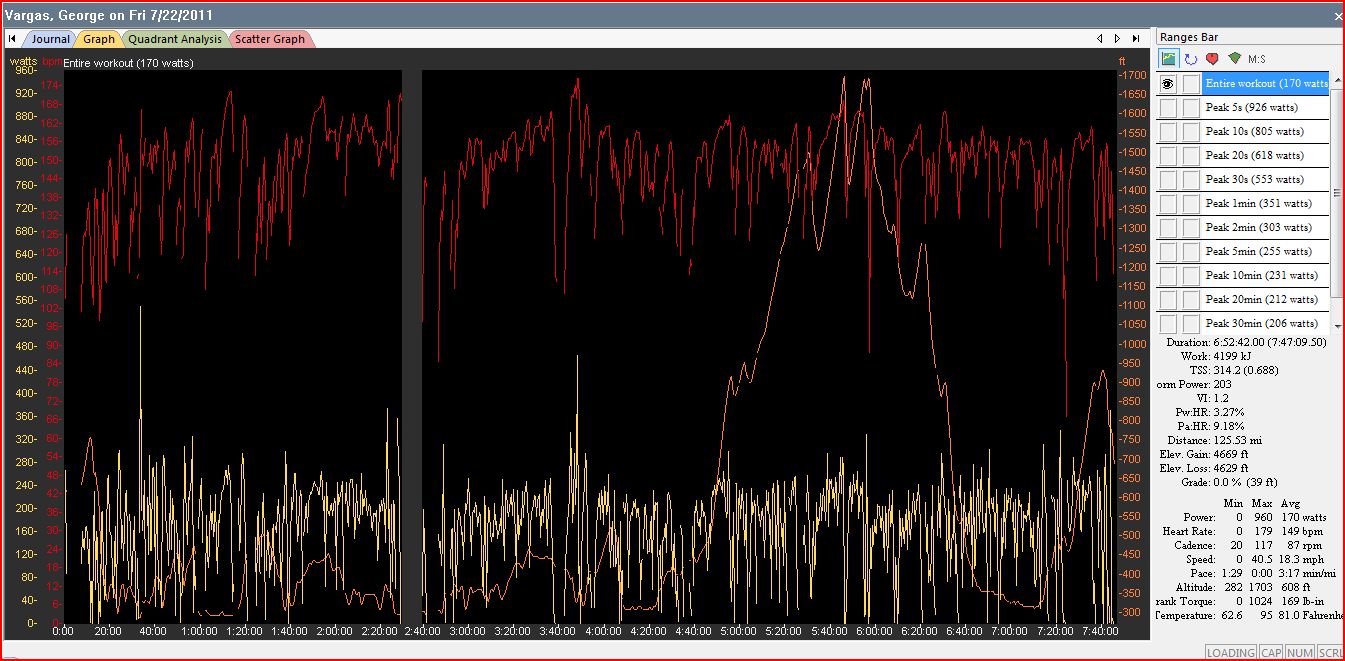
Thursday 130 miles with 9,500 feet of climbing (9,000 in the first 50 miles) and Friday another 100 miles on the coast. On Thursday, I hitched a ride to Glendora with some friends.  I climbed Glendora Mountain Road (GMR) descended and topped off my bottles at Camp Williams.   I then cut across on East Fork and climbed from below 2,000 feet elevation to  Dawson Saddle (7901 Elevation) on Hwy 39. My friends didn’t want to climb to Dawson Saddle so I “stranded” myself and I rode home from 84 miles away.  I told my friends that they did not have to wait for me while I kept climbing and that they could go home.

A training note:  This was a 400 mile week.  One of the greatest challenges of riding that many miles is RECOVERY.  Eating enough calories and protein to rebuild your muscles overnight is very important.  Proper hydration during my ride on Thursday was very challenging because of the remote nature of the course (refer to this post on Dawson Saddle).  I spent the rest of the day on Thursday re-hydrating so that I could be ready for Friday’s century.  After Friday’s century I was still dehydrated because I only stopped once to fill my bottles and rode for six hours on four bottles.

Today- another 100 miles with sore legs.

and now for some fun…

Swiftwick Socks

From L to R: Heidi, George Vargas, Johnny, Geno and Chris

Camp Williams General Store- water spigot located at the base of tree to the right backside of Glendora Mountain Road or Little GMR as some call it.  

Dawson Saddle- the summit of a 35 mile climb from Duarte

George “Red-Eyed Vireo” Vargas summits Dawson Saddle

George “Red-Eyed Vireo” Vargas view from Crystal Lake (5200 feet) looking up.

Product Review- 2011 Felt F1 with Di2- Felony is born


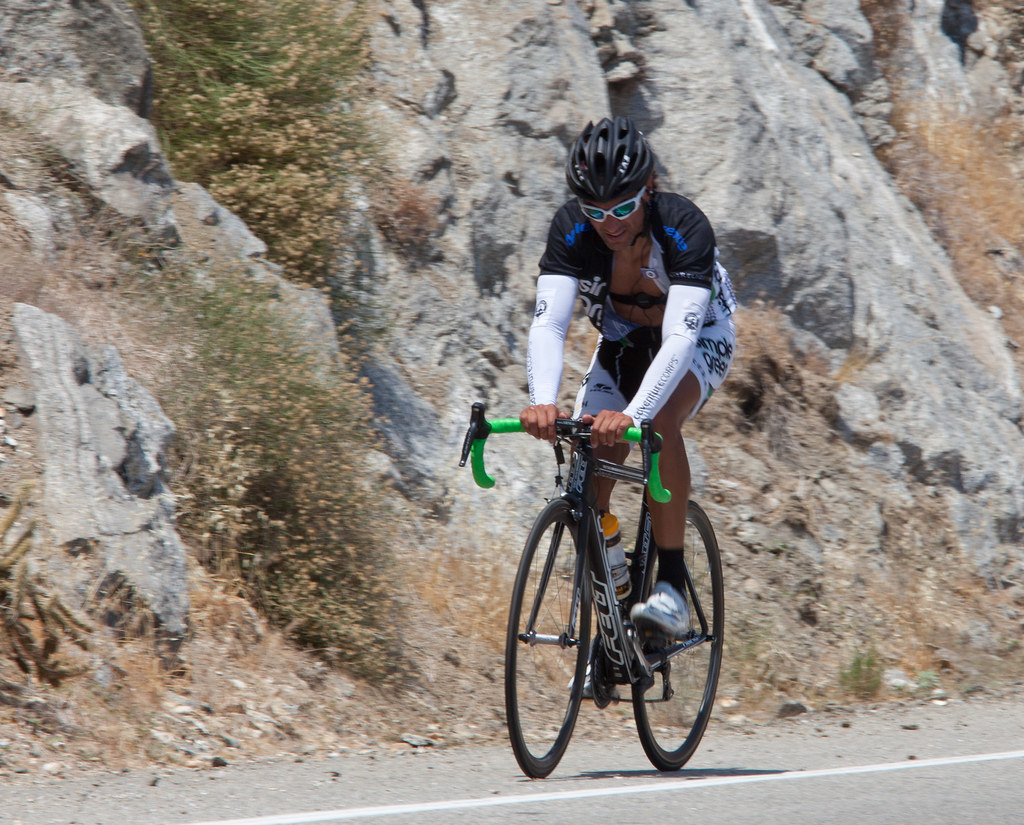
George “Red-Eyed Vireo” Vargas climbing Montezuma Grade (12 mile 3,400 gain) from Borrego Springs to Ranchita in the desert climate of California east of San Diego

My 2011 Felt F1 has taken me to great heights including a Personal Record in the 2011 Breathless Agony climbing century with a new PR of 5 hours 24 minutes.

It is with great pleasure that I write the review on the 2011 Felt F1.  Last year I rode the 2010 F2 with Di2.  As the 2010 season came to a close I was very excited to ride the redesigned 2011 Felt F1.  All I needed was a frameset, so I could use my Shimano Dura-Ace Di2 components, SRM 7900 wireless crankset powermeter, Shimano Dura-Ace wheels, cockpit, saddle and Dura-Ace pedals.

Below you will find the breakdown of the components I used including their weight — claimed versus actual.

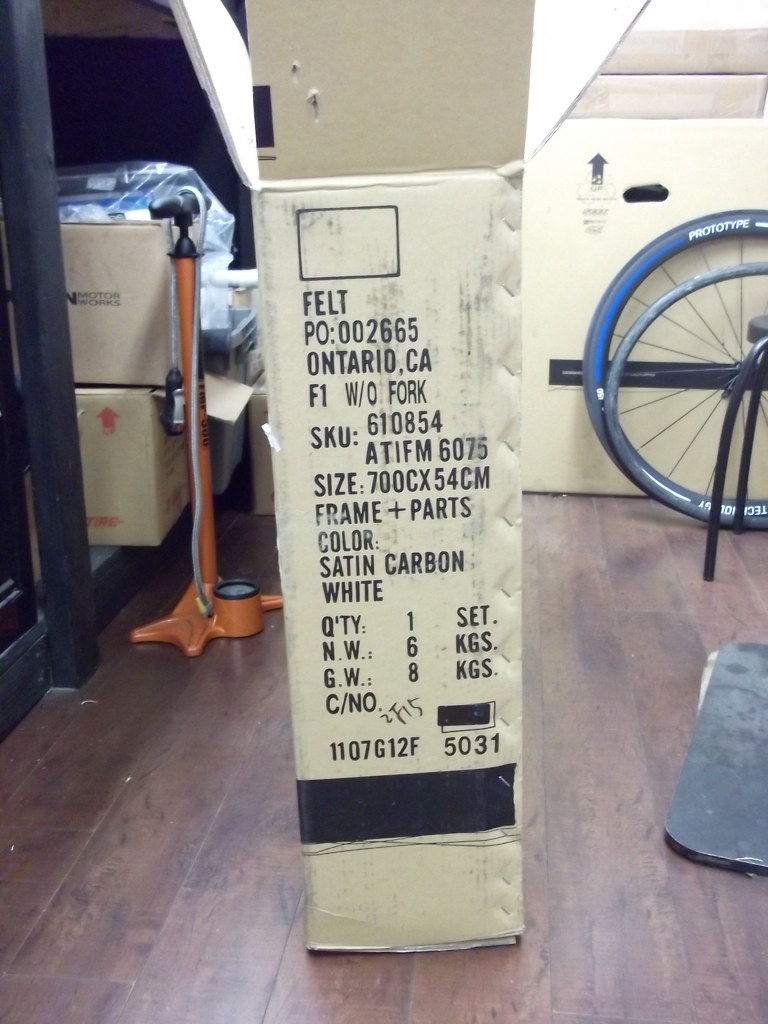
Felt Bicycles is located in Irvine California and has their warehouse in Ontario, CA

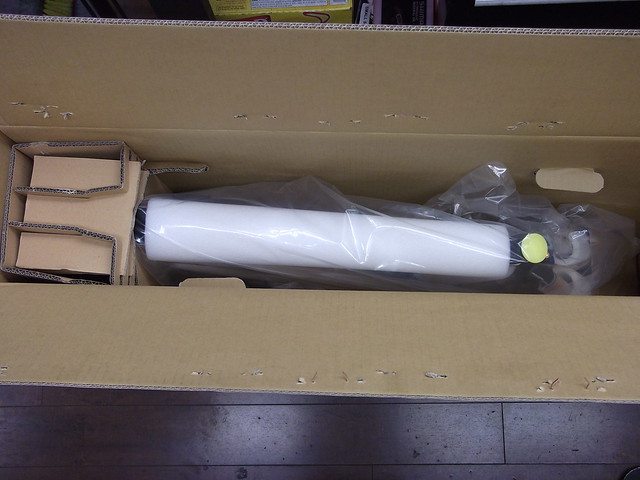
Felt Bicycles does a very good job packing and protecting the precious cargo within.

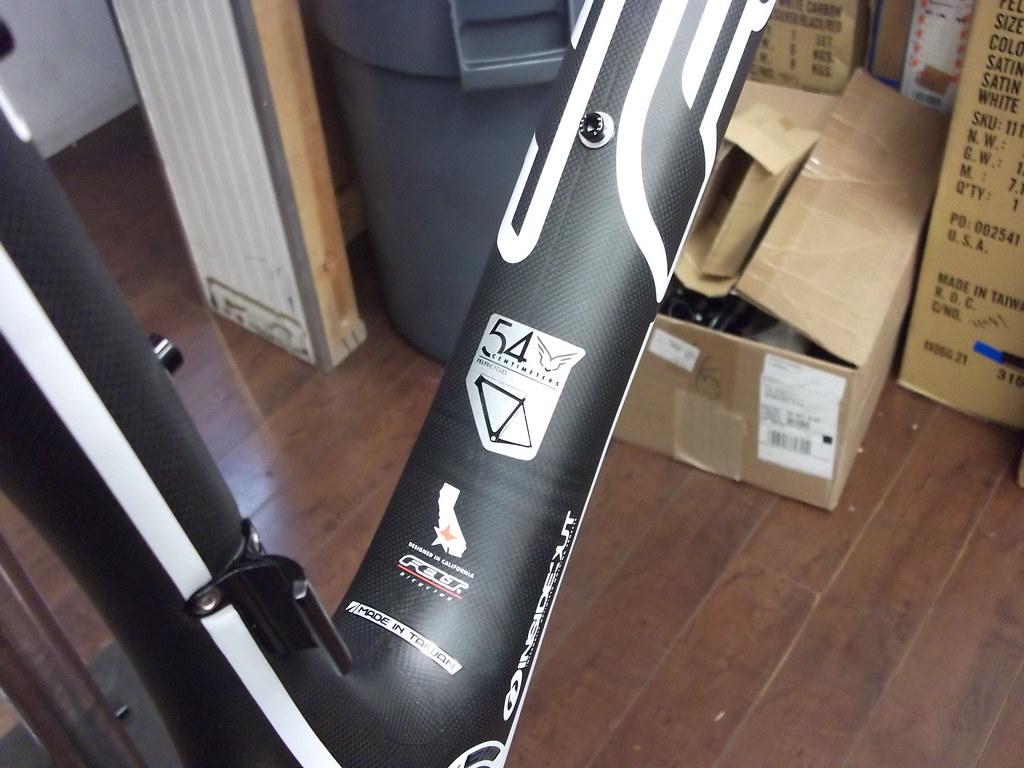
The 2011 Felt F1 54cm now has a 73.5 degree seat tube angle.  2010 had a 74.5 degree seat tube angle.  For the 2010 season I rode a 56cm F2 so that I could use the 73.5 degree seat tube angle. Personally, I prefer 73 degree seat tube angle.

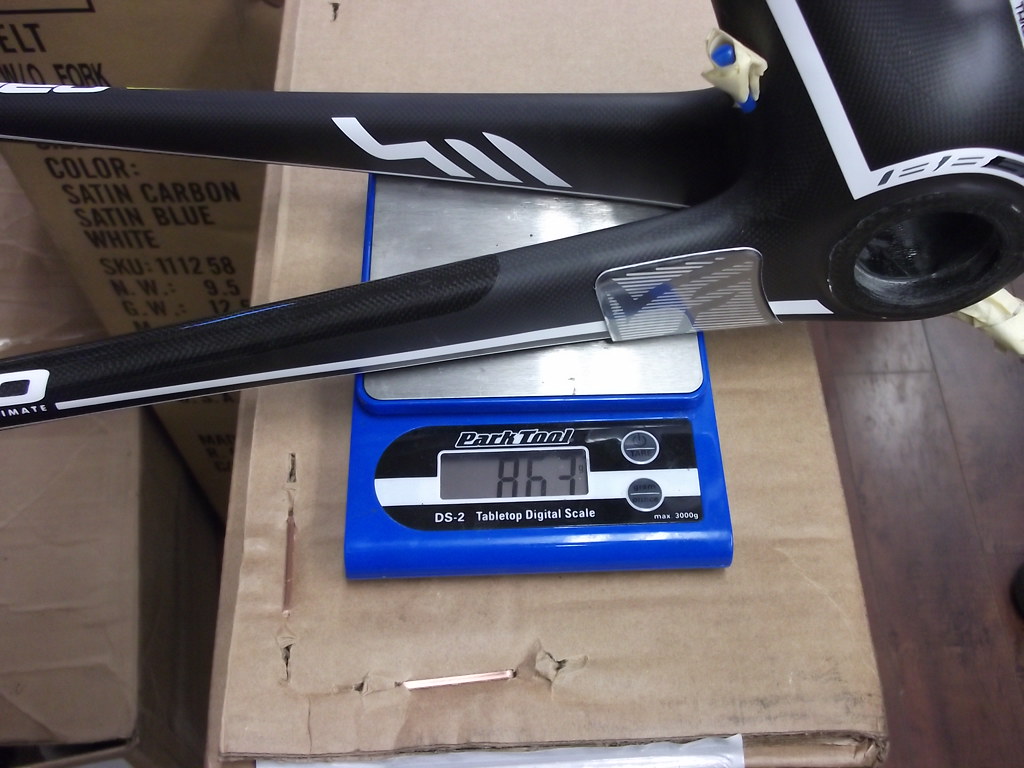
2011 Felt F1 frame with derailleur hangers, bottle cage bolts, shift cable “noodles” and seat post clamp. 

Weight of just the “noodles”

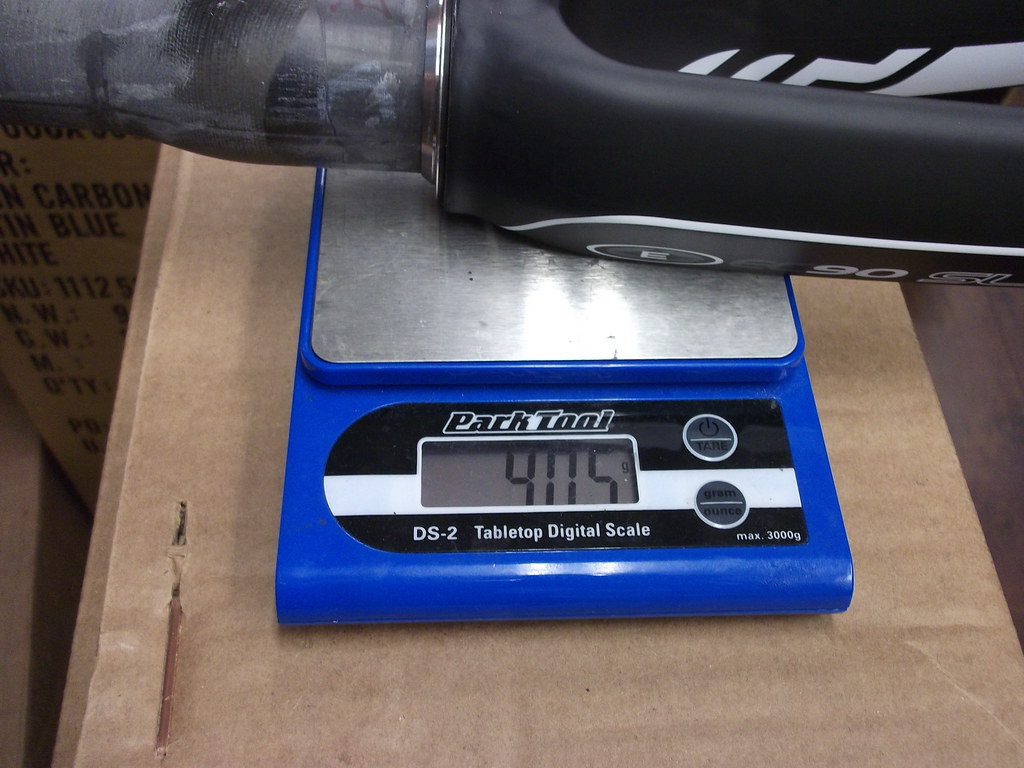
Weight of Easton EC90 SL tapered fork …uncut

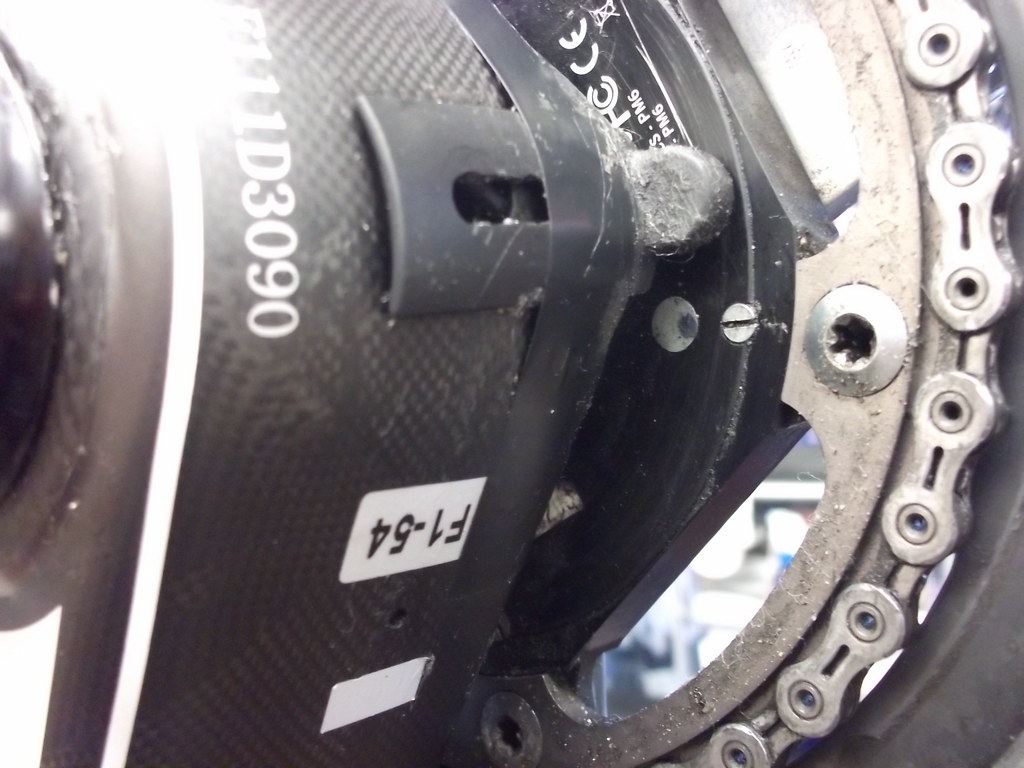
2011 Felt F-Series bicycles now come with an all carbon BB30 bottom bracket shell.   The bottom bracket is manufactured with a shoulder.  The first hurdle I encountered during assembly was not being able to use the Shimano external cup bottom bracket.  I use a SRM Shimano 7900 Dura-Ace wireless crankset power meter.  The Shimano crankset is a standard 24mm crank  So what were my options?

1.  FSA Bottom Bracket aluminum sleeve

2.  Felt supplied bottom bracket adapter

3. BH bearings

I chose option #3

Option #1- seemed somewhat permanent to me.  You have to press in the sleeve that reduces the 30mm down to 24mm.  I figured in an all carbon bottom bracket shell if I ever decided to take the sleeve back out I might damage the shell.  If you decide to use it the external bottom bracket bearing cups just screw in like a normal bottom bracket and the 24mm crankset installation is uneventful.

Option #2 – I remembered having issues on another customer’s bike assembly and just passed on it.

Option #3 – I remembered having a positive experience on several other BB30 bikes including the Felt F1 and so I went with it.

A word on BB30– I know all the technical reasons and merits for such a new standard.  But in my experience, in a shop environment, I have not seen where BB30 is that much greater than the 24mm standard.  Time and time again bikes come in with creaky bottom brackets and 95% of the time it’s a BB30 system.  Cannondale pioneered the standard and they make a REALLY light crankset to go with their BB30 bottom bracket.

Is having the crankarms closer to the frame (Q-factor) necessary in all applications?  Add to it the lack of durability (bearings aren’t sealed properly) and you end up with a system that requires a lot more maintenance.  I have had Shimano Dura-Ace external bearing cups on some of my bikes for years and years and thousands of miles and never had to replace one.  When I asked the road product manager why BB30 he responded “to have more crankset options”  Agreed you now have more options but I personally don’t think it was necessary.

I digress, option #3, requires you to mill down 3mm so that the cups can be fully inserted against the shoulder in the all carbon bottom bracket shell.

After being milled down notice the stock and milled 3mm

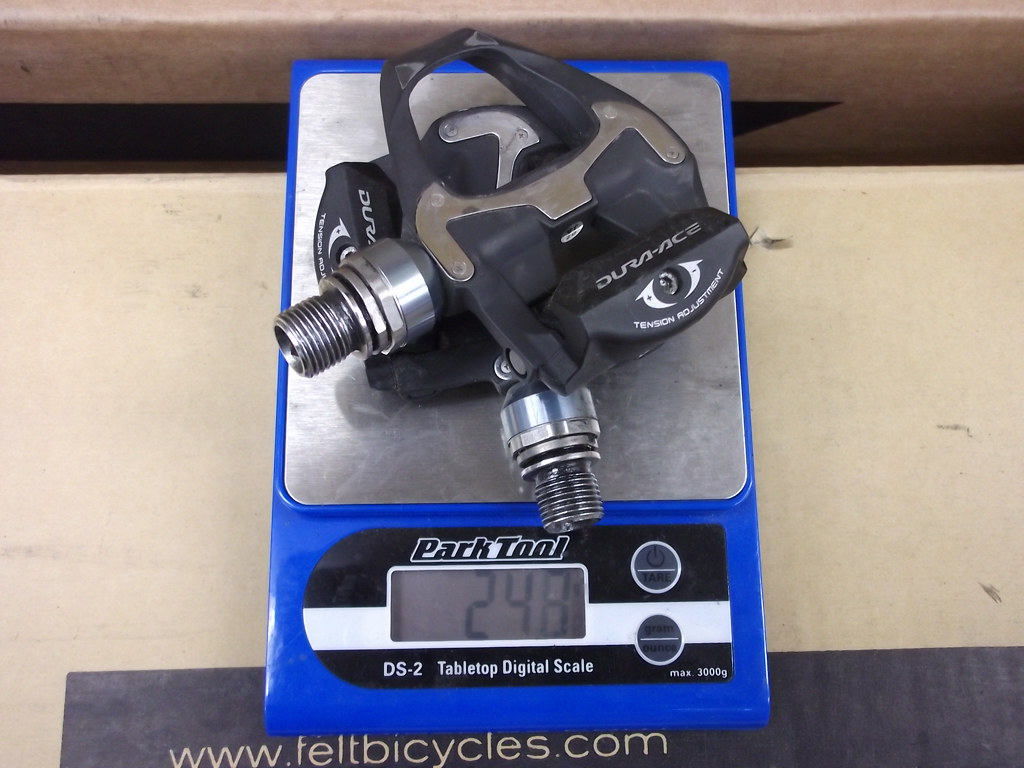
Shimano Dura-Ace 7900 pedals claimed 248g actual weight 247g

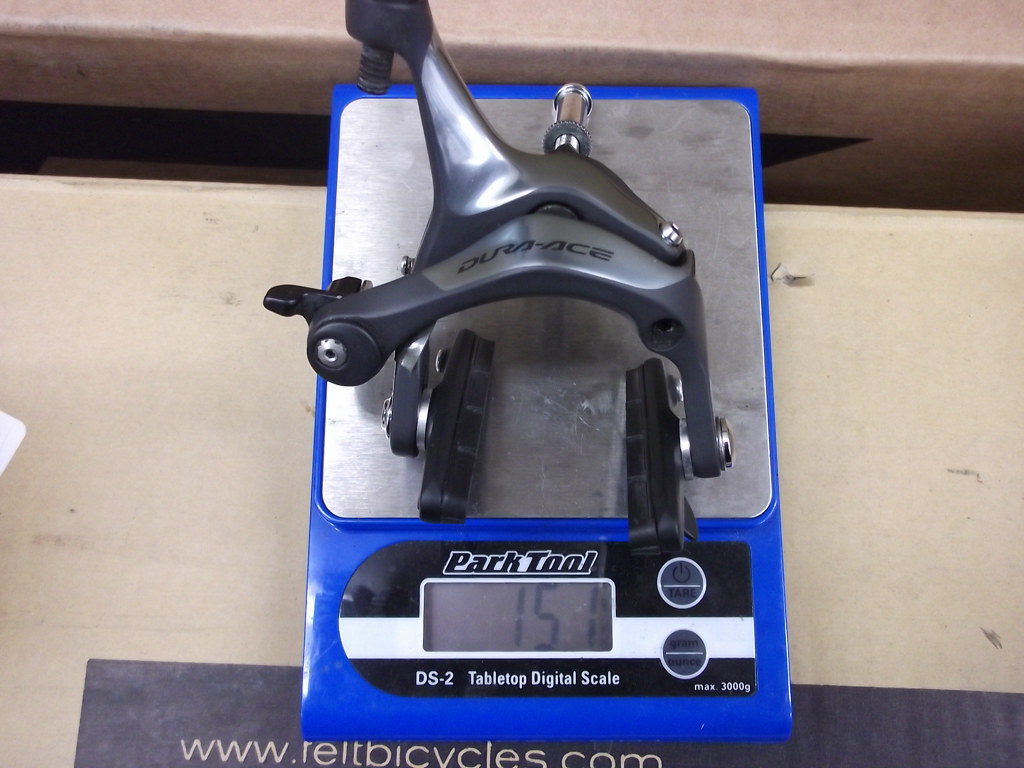
Shimano 7900 Dura-Ace rear brake caliper

Shimano Dura-Ace 7900 front brake – claimed 293g for the pair actual is 295g
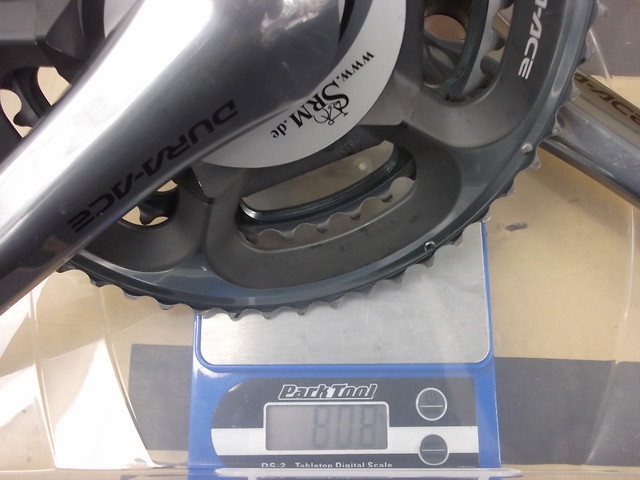
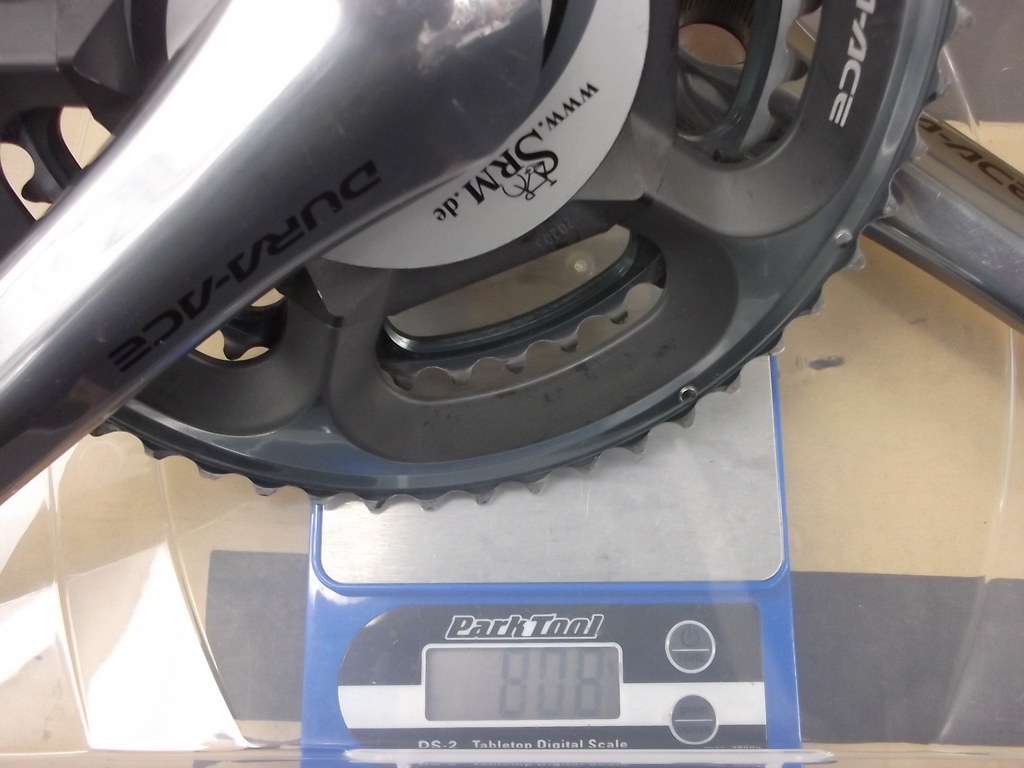
SRM Dura-Ace 7900 wireless crankset power meter

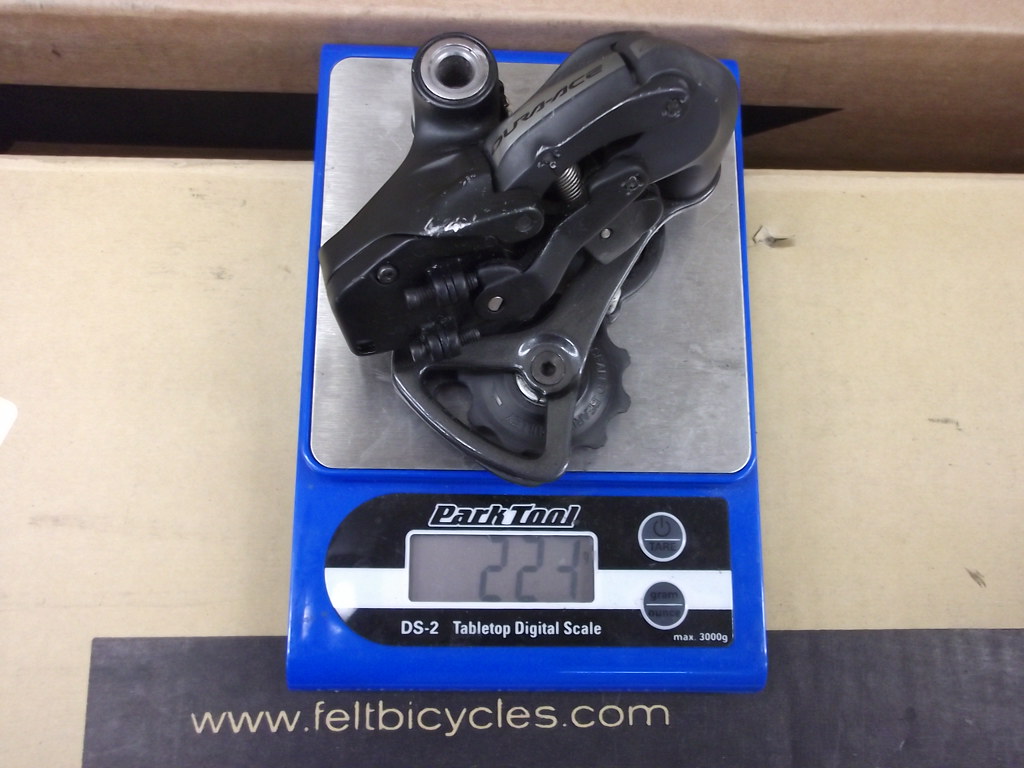
Shimano Dura-Ace Di2 rear derailleur advertised at 225g actual 223g

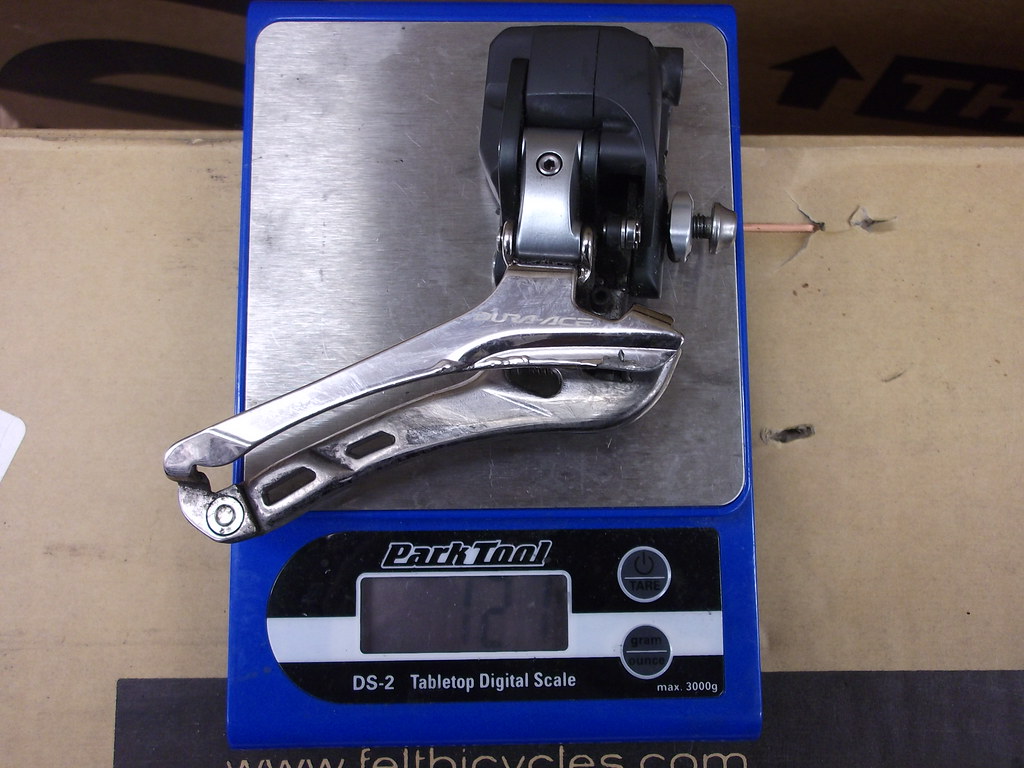
Shimano Di2 Front Derailleur advertised 124g actual weight 121g

Profile Design Elite Karbon Kage advertised at 16g actual weight 16g!

Easton EC90 Seatpost advertised at 200g actual weight 194g

Fizik Airione Versus saddle advertised at 239g actual weight 243g

Shimano Yumeya Chain

Shimano Yumeya Chain

TiN (Titanium Nitride) plated inner links which improves stretch durability by 18% while increasing oil retention, which also indirectly increases chain life. Thus, for a little bit more money, you get a longer lasting chain that rides quieter and arguably looks much better. The 7900 Yumeya chain still features Shimano’s directional outer links for better shifting all around, and remains super light with it’s hollow pins and hollow inner links.

Features

  • 7900 Yumeya chain weighs 258 grams
  • 18% increased chain durability
  • Increased oil retention
  • TiN plated inner links
  • Hollow Pins
  • Hollow inner links
  • Profiled outer chain links for smoother, quieter shifts

Complete bike weight with Shimano Dura-Ace C24 carbon clincher training wheels.  You can always make the bike lighter.  I have a full Dura-Ace group and we all know that Shimano is more interested in high quality, dependability, and durability than being the lightest in the industry.  Being an Ultra cyclist, I really appreciate Shimano’s conservative approach to design.  I do lots of miles and many times I’m out in the boonies or on closed roads.  I build my bikes with components I can trust.

The Ride

Ok so now that we have covered all the technology and weights and measures how does the bike ride?  It rides like a full-on race bike!  Felt Bicycles did a fantastic job in making that happen.

I built the bike after work and just HAD to get out for a test ride that evening.  I chose a flat 20 mile ride along Pacific Coast Highway from Newport Beach to and through Huntington Beach.  The usually annoying traffic signals provided me with the opportunity to perform numerous standing starts from a trackstand.  I was surprised the first time I really stomped on the pedals and looked down and saw that my max wattage was over 1,000 watts.  I was like “wait what the…”  So at the next traffic signal I slowed, did my trackstand and BAM! stomped on the pedals and again another 1,000 watt effort.

Alright this is quite unusual for a guy like me.  If you follow my blog you know that I am an Ultra Cyclist and rarely does an ultra race (200miler and above) come down to a sprint finish.  I don’t train to have a massive sprint or anything even remotely similar.  I train to have endurance and tempo forever as my friends like to say.  My first thought was that my SRM must be reading high so I pulled over and redid the zero-offset.  But that didn’t matter because I hit over 1,000 watts on two more occasions.

I started making some deductions…if the bike is light and the bike is stiff then it must climb well 😀  that would remain to be discovered since it was late in the day and no time to hit any climbs.  After the initial excitement in discovering I actually had a sprint 🙂 attributed to the awesome bottom bracket stiffness I began to focus more on the Felt F1’s road manners i.e. ride quality.  That’s when I realized the front-end was a little too stiff for my liking.  The new frame has a 1.5″ bottom bearing in the headset with a tapered headtube and tapered fork to match.  I think it might be too stiff for the recreational rider but then this bike wasn’t really made for that rider was it?

When  I spoke to the Felt road product manager he acknowledged that the front end could use a little more refinement.  He mentioned to me that a new fork is in the works and will help with the front end ride quality.

Aside from the front end this bike is loads of fun on ascents and descents.  Since my first test ride on this bike in May I have done several thousand miles and I am thoroughly enjoying it.

Here are only a few of the epic rides I have done with my 2011 Felt F1:

Breathless Agony Climbing Century– May 5- 112 miles (70 miles with 11,000 feet of climbing)

Newport Beach to Dawson Saddle-  May 14–168 miles with 11,300 feet of climbing

Angeles Crest Highway— June 24– 100 miles 12,000 feet of climbing

Lake Henshaw Climbing Camp– July 11 100 miles 10,200 feet of climbing

In addition to these epic solo climbing rides I have also done many club rides which test not only my abilities as a rider to stay in the pack but the handling characteristics of the bike underneath me.  The Felt F1 is in my opinion a full-on race bike!! It is stiff it is light and it handles extremely well.  It needs just a few tweaks to provide it with a little more finesse to enter the world of the “superbikes”.

I would rate this frame a 4.7 on my scale of 1-5, 5 being perfect.

George’s next Epic Adventure– Park City Point to Point MTB race


That’s right folks I’m going outside my comfort zone of road bike ultras.  I will be doing the Park City Point to Point Mountain Bike Race.  The organizers say it is about 80 miles with 14,000 feet of gain and 90% single track.  Starting elevation about 7,000 going to 9,500 feet.  I wish to thank my good friends at The Pro Bar (the best tasting bars 😉 ) for getting me in entry to the event which sold out in 6 minutes!! By some accounts it is much harder than Leadville because it is much more technical without the fire roads and paved sections.  I function relatively well at altitude but I’ve also been doing CVAC sessions which will help me race at altitude. 

I have only been on a MTB three times in my life and it doesn’t look like I will get much time between now and September 3 to train on a MTB. 

What are my expectations?

1.  To finish

2.  To not crash too badly so that …. refer to #1

3.  To ride comfortably and finish mid-pack…refer to #1

http://connect.garmin.com:80/activity/embed/46300350

Here is the Garmin Connect player for the event

Cannondale Test Rides – Scalpel 29’er and SuperSix EVO


I just got back from Dealer Camp held in Park City and Deer Valley.  I rode two fantastic bikes the new full suspension 29’er mountain bike from Cannondale the Scalpel and their new top of the range SuperSix EVO road bike.  I was thoroughly impressed with both bikes and will write an “initial impressions” report as soon as I get caught up from being gone three days in single track paradise.

Epic Training Athlete — Vineman Testimonial


One of the most gratifying things I do in my life is coach other cyclists.  Helping them realize their dreams fills me up with pride, a sense of accomplishment for them and for me and completes me as part of the human race.

What follows is a testimonial from an athlete I coached in preparation for the Vineman half-ironman.  Her email gave me chills…

I’ve known George for years but this last year I engaged him to coach 
me for the Vineman ½ Ironman distance triathlon. We started working
 together in January when I flew out to California to pick up my new 
bike, wheels with a power tap and to do some field tests to establish 
baseline power data and benchmarks for workouts. George was patient in

the beginning as I asked tons of questions about understanding the 
power data, what it meant and why I should care.
This was the first time I had ever worked with power data. Actually, 
I rarely even rode with a computer or a heart rate
monitor in the past. I was all about “having fun!”

We had a rough start to the training. Training in Colorado outside in 

the winter just doesn’t happen, so the beginning of my training rides 
were inside, on the trainer: mentally challenging but effective. And 
frankly, I can’t say that once I started riding outside in the spring 
it got any less mentally challenging. This was one of the worst 
springs in Colorado.

I had so many freezing cold rides where I pretty much crawled down 
the road that I thought it was never going to get better. Those early 
rides were just a creating a foundation for the “real thing”. In April,
 I had a 17 mile Time Trial. I’ll never forget the call with George 
saying not so gently that I spent 85% of my ride at a cadence between 
60 and 80. Not good at all! After he chewed me out about that…the 
good news, I had strong power data: a 10% improvement over my last 
test. Keep up the good work!! I was a horrible spinner and I knew that
already , I just wasn’t expecting George to be so relentless. 
“How are you going to ride fast if you can’t pedal fast?” is what he 
would say to me and over and over again. So, I had tons of drills 
both on and off the trainer to improve my
spinning skills. It was not easy for me and a topic of many 
conversations but I did get better.

Besides my cadence, George was all over me about my weight. 
Once I got over my emotional baggage about it and understood that it 
wasn’t personal the weight came off – slowly for sure. George was 
always presenting the weight issue from a technical perspective – 
watts per kilo and how good it would be to lose weight and improve 
power! In the end, I dropped just over 10 pounds. People were noticing 
how good I looked. All my friends knew I was working with “George” a
nd they got used to me going on about what I called the George Factor. 
The daily emails about my food,weight, HR, my uploaded power data,
 my workouts, how the ride went, our discussions over cadence, 
my monthly tests, the weekly conference in calls, etc.

Slowly, there were small victories…the weight loss, the solid rides, 
and the monthly improvements in my field tests. The real proof came 
one day riding with some friends up Carter Lake. I would have normally
been last up the hill…and by minutes…but this time I was third and 
feeling strong. A call to George at the top was the highlight of the 
ride!! The training was working! 
It wasn’t always easy juggling the cycling workouts alongside a crazy 
work schedule and the other activities I was participating in, 
especially the Crossfit workouts that I was doing. With Crossfit, 
there is a lot of aerobic strength training with “heavy” weights and 
George was worried that I was going  to bulk up…or rather that 
I wasn’t going to slim down. It’s all about  the watts per kilo he 
would tell me over and over again. Watts per kilo! Watts per kilo! 
And just in case I forgot. Watts per kilo! Less weight on the bike 
will make you faster. 
Again, I had to remind myself that this wasn’t personal…it was all
 about the bike! Additionally, George isn’t a fan of “junk” miles 
and believes that rest is more important than trying to make up missed
workouts. He learned that I like to quilt and when he sensed 
anxiousness over missing workouts in my voice or emails he would say, 
“Do I need to schedule in time for you to quilt?” In other words, 
just chill girl! Everything will be just fine. That’s when I 
understood that he always wanted the best for me.

A few weeks before my race, I had a practice day of an hour swim, 
a 33 mile bike and an hour run! I sent my report to George and we 
both agreed, “I was ready”. 
Before the race (Vineman) we talked about my power 
and time goals. My power goal was 200 watts with a time of 3
hrs30min. George said I should target 3hrs15min so 3hrs15min it was! 
I didn’t have the pre-race jitters like I normally do. I hadn’t 
really trained on the swim or the run so I was just going to go for 
it on the bike. I had one of my best swims ever and onto the bike I 
went! I previewed the course before hand and knew it to be very rolly 
with a couple of hills, lots of twists and turns and very bumpy roads. 
All I could hear in my head was George saying to me, “If I felt the 
bumps in the road, I wasn’t racing hard enough!” Okay, George, I never
 felt the bumps so I guess I was racing fast enough! When I was about 
14 miles from finishing, I looked at the watch, did some calculations
and thought…geez if I push a little harder I just might make that 
3hrs15min goal. In the end, I completed the bike in 3hrs 21min! I felt 
strong throughout the entire ride and I even passed other riders on 
the hills! That’s never happened before. I had a kick ass GREAT bike 
ride for me. 
I was super excited and smiling in transition. Now onto 
the run. Certainly not my strength. Actually, I pretty much suck at 
running so I simply headed out with smile on my face saying it
will be what it will be. I negative split the run which is unheard for
 me. I had one of my best runs ever which I attribute to being so 
solid on the bike. Overall, I had a super solid, awesome race. One of 
my best races in years! I uploaded my data to George later that day.

 My average power: 197 (great job) and my cadence was over 85 (great 
job). He was proud of my effort…and so was I! For me this year, it was
 all about the bike and it paid off with a great race! George was a 
good mix of compassion and hard ass for which I am truly thankful. 
He is extremely technical/knowledgeable about reading and understanding
power data. He took a personal interest in my success unlike previous 
triathlon specific coaches I have had and I felt accountable and 
wanted to get better. 
I would certainly recommend George as a bike coach for anybody that 
wants to improve. I am doing an Ironman next year. I think I’m going ]
to start mentally preparing myself for the “George Factor”. 

Thanks for everything George. Lida