Hi there,
George Vargas just shared an Instagram photo with you:

“Roland and Red Eyed Vireo”
Thanks,
The Instagram Team

Hi there,
George Vargas just shared an Instagram photo with you:
“Roland and Red Eyed Vireo”
Thanks,
The Instagram Team
Hi there,
George Vargas just shared an Instagram photo with you:
“Almost ready to launch Grand Tour Highland Double Century #swiftwick #revcycling”
Thanks,
The Instagram Team
Tomorrow I will be doing the Malibu Grand Tour Highland Double Century withLori Partridge Hoechlin on the tandem follow this link to my SPOT transmitter during the double century. We will be rolling about 530am
TIP: When the link opens up on your computer or Smartphone you may want to zoom in or out to actually see the streets. I have found that every time I go to the shared link it is zoomed all the way in and you can’t see street names.
I wish to thank Brad Horton with Global Star for his unmatched customer service and SPOT sponsorship!!!
http://share.findmespot.com/shared/faces/viewspots.jsp?glId=0MfUqq7lNGkpV5h7jKH47YC52nl5dbRgc
Hi there,
George Vargas just shared an Instagram photo with you:
“”The Machine””
Thanks,
The Instagram Team
Oh my. Where do I begin? This is a post that’s been a long time coming. I have so many things to say I actually don’t know where to begin.
In the last two days I have seen two examples that have motivated me to finally write a blog post about Strava. The first thing was when I heard that Strava properly defended themselves from a lawsuit of a grieving family. Apparently, a Strava user was attempting to improve on his time on a downhill road segment and was killed in the process. The prosecuting attorney’s argument was based on holding Strava to the same standards just as a race promoter. Ludicrous but they had to try something. You can read an article here. The second reason was watching one of my friends suffering miserably during a group ride. These two instances got my juices flowing!
First, let me provide a little background. Strava is a social fitness website where riders who are equipped with GPS devices, Garmin being the most common, ride on certain segments, think stretches of road, download their data, and then see how they fare against other riders who have ridden that same stretch of road or segments. It can be a great resource for riders who want to track their mileage, track performance against themselves and other riders.
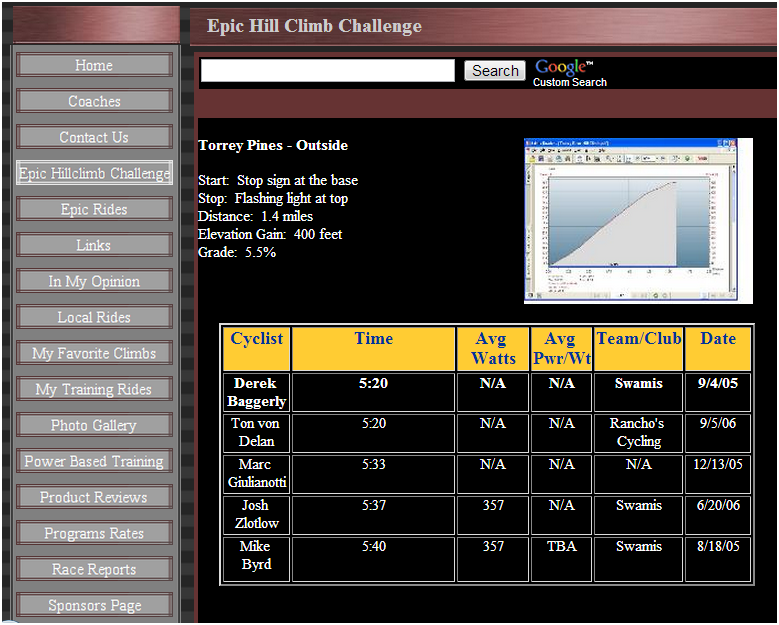
What’s interesting is that I was doing a form of Strava back in 2005 and I would post the results of certain local hill climbs on my website. I would have people send me an email and then I would post their times. Here’s a screenshot from my coaching website that is now more of an archive than an active site. Here is the link.
OVERTRAINING
I will begin with how I believe Strava can negatively affect someone’s training and overall health when not used under the supervision of a trained professional. Strava provides different types of competition for its users. One form is via a mileage challenge. These challenges take on several different forms but each follow the same basic premise – riding a lot of miles. The most common form of mileage challenge is a competition to ride the maximum amount of miles. The time frame for this type of competition is usually an entire month. A variation of that may be to ride a prescribed amount of miles to parallel a professional cycling race. Below are two examples.
1. May Massive was a worldwide competition to see who could ride the most miles in the month of May.
2. 700 miles in one week, which will equal the distance of the Tour of Colorado a race done by professional bike riders.
This can be a fun and entertaining way to track your monthly mileage and see how you compare to other people around the world. In many cases, it motivates someone to ride more often. And that’s a good thing, but like most good things – too much of a good thing can actually be a bad thing.
Let’s take the first example of the May Massive. In this competition you are competing against all cyclists from around the world that have enrolled in the challenge. There can be as many 30,000 to 50,000 cyclists participating in the competition. When I have looked at the top 10 overall in these competitions I have found the mileage totals to be completely absurd. I think to myself, there is no possible way these people are legitimately riding that type of mileage.
Now let’s look at the second example where you are riding 700 miles in a week just like the professional peloton is doing during the Tour of Colorado. While it may be possible to ride the 700 miles in a week’s time, we as recreational cyclists, are at a huge disadvantage to the cyclists. Professional cyclists are fed at least three nutritious meals, provided with ample time to rest between stages, provided with daily massages and their job IS riding their bike. I’m quite sure I could ride 700 miles in a week while being provided that type or high level of care of course without the racing part 🙂
As a coach I look at things quite differently than say a novice bike rider. Here is where I sometimes see where Strava can do more harm than good. Let’s take my friend as an example. She recently competed in the May Massive mileage challenge. She was determined to be in the top 10 for women across the country and the world and this meant that she had to ride A LOT! If I remember correctly, she did accomplish her goal but to what end? Who really cares save her? My personal opinion is that the May mileage was too much. But that wasn’t enough for her because she then joined the June mileage challenge.
About three days into the June challenge we were on an evening club ride and she was having a very tough time staying in the group. She had ridden 62 miles earlier in the day and was now on 22 mile hard ride. Why two rides in one day? Well, because how do you accumulate that many miles without riding long miles or even two workouts in one day. I didn’t say anything to her that night. But it should have been obvious to her what was going on. I mean she even made mention that she had ridden 84 miles today and hadn’t received any trophies (awards for fast times on segments).
The following morning as we were headed to another group ride of 40 miles. I began to query her about her training and recovery habits. Being a former financial planner and a very experienced salesperson I don’t ask questions if I don’t already know the answers. I asked her how many rest days she was taking during the week. I asked her how often she was taking a recovery week during the month. I also asked her how often she goes out on a recovery ride. Each one of these questions and her answers was building a case for me as I easily walked her into the realization that she was overtraining. She even admitted that when she goes out on an easy ride she does not accomplish her goal of doing an easy recovery ride. She said she goes out with every intention of doing an easy recovery ride, but somewhere during the ride she picks up the pace and it turns into an easy/medium ride or an easy/hard ride. Furthermore, if she sees a segment she will attack that segment because she’s had such an easy riding day what harm can it do? I advised her that if she can’t have the discipline to go easy on an easy day than she should sleep in and stay home!
This all came to a head later that afternoon. I was so frustrated with her lackluster performance on our group ride. She was lagging and getting split at lights because she had no umph! No surge, no sprint and no acceleration. I had to physically push her on the flats because she kept opening gaps in the paceline. I was so disappointed that she couldn’t see that riding 400 miles the last six days had done her in. She looked tired …hung over even.
I spoke to one of our mutual friends and in a joking sort of way said we needed to perform an intervention on our friend, and she knew it immediately what I was talking about. We both realized that our friend was addicted to Strava Yep addicted to Strava sounds funny, but it’s true. You see, there is yet another component of Strava that can lead you to overtrain. On Strava, you have people following you and they can give you Kudos or leave comments on your ride. I believe that my friend has gotten caught up in all the attention she receives from all her followers. Furthermore, I suspect that the positive affirmations to her riding has fueled her desire to ride more and receive more comments and so on and so on it’s a cycle If you will.
My next point is somewhat unique to my friend’s situation and other people like her. She has a lot of free time to ride. She doesn’t have a 40 hour workweek to contend with and her children are grown and out of the house. So what you have here is an example of the triple whammy. A social website that promotes and encourages riding a ton of miles, a rider who doesn’t have a coach or training plan with no direction and plenty of idle time and is possibly fueled and enchanted by the positive feedback given by her virtual friends from around the world telling her she is doing a great job. Yeah a great job running herself into the ground!
My friend has been riding so much in an effort to do well on these mileage challenges that she has been ignoring the basic fundamentals of training. What are those fundamentals? In their simplest form, it is to provide your body with stress and then provide adequate time for it to adapt to that stress. We understand this concept very well when we lift weights at the gym. We know that we can’t go into the gym and do hamstring curls and leg extensions, six days a week. We know that on one day we may work on our upper body. Another day we may work our lower body. So why don’t we get this concept when it comes to the bike? Yes, the bike has less impact on your body and because it is such a light load repeated throughout a three-hour training ride it’s possible we don’t make the correlation to our gym experience.
I consider myself fortunate enough to be very self-aware of my body’s limitations and its ability to adapt to stresses I put upon it. I’ve been riding long distances for 10 years. In the past decade, I have been able to learn when my body is asking me to cut back on mileage or come to a screeching halt and REST! As a matter fact, one of the reasons I have the time to write this post today is because I am on an ad hoc rest period of two days. These rest days were not in my training plan but I was feeling tired, lethargic and not motivated to ride Thursday morning. What’s more is that my performance has been fantastic over the last couple of weeks and even as recent as a couple of days ago. So there were no signs or indicators that I was training too much or too hard and that I was wearing down. However, if I wake up and I’m not motivated to ride then my body is telling me something and I need to listen. I believe my body was asking me for rest and so I have been relaxing and napping for two days. When is the last time you napped?
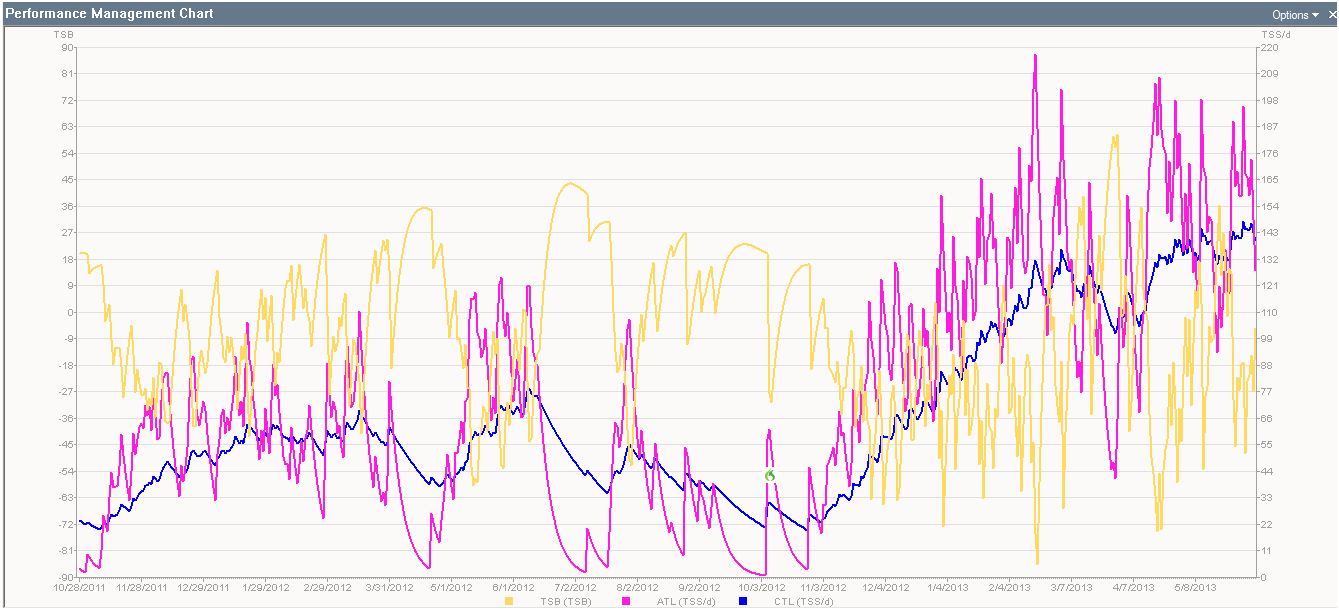
What if you are not body aware? What if you are still learning how to interpret the signals your body is sending you? Well, then I strongly suggest as a coach and that you acquire a power meter and then immediately buy a subscription for Training Peaks WKO +3.0. There is an awful lot of data that is collected by the power meter. The Training Peaks software allows you to analyze that data with many different charts and graphs. One chart, in particular that is very important in how I assess the progress of my training is the Performance Management Chart. Below is an example of my Performance Management Chart.

Many of you that follow my blog have seen this chart before, but just so that everyone understands what all the squiggly lines mean here is a brief explanation.
Pink line-indicates the amount of stress you have put on your body averaged out for the last seven days.
Yellow line– indicates the amount of rest and recovery you have given your body.
Blue line-indicates the amount of stress you have put on your body averaged out over the last 42 days or six weeks.
What you want to see is the Pink line going up and the Yellow line going down during your build process and then when you give your body a recovery week you should see your pink line and your yellow line coming towards each other. The Blue line should be slowly creeping in an upward direction until you reach your A race/event, your most important event of the year. As you can see from my chart there have been multiple times during this training season that I have taken a recovery week indicated by a plunging PINK line. I have also identified the two events that I have done this year. The Death Valley Double Century , March 2 and the Central Coast Double Century May 11.
There is a much more in-depth discussion that can be had on how the Pink, Yellow and Blue line are calculated. But I think you can graphically see how I have designed my training plan to provide stress and allow appropriate time for adaptation. As your coach, I would monitor the Performance Management Chart along with constantly asking you how would feel. I would ask for feedback on how you were adapting to the stress and we would tailor and structure your training plan accordingly.
A properly devised training plan is based on hours not miles. The body doesn’t know how to recognize how many miles you have ridden it only recognizes duration and intensity.
Your Training Stress Score is what your Performance Management Chart uses to calculate the amount of stress your body has received. A 50 mile ride especially a hilly one may have a higher TSS than say a 75 mile flatter ride with more traffic lights, coasting or even riding in a pack with the benefit of drafting.
In other words, it’s quite possible to have the same training effect with much fewer miles and because a mileage challenge requires a certain number of miles or maximum total amount of miles for the month you may be overreaching and overtraining
Just for kicks I providing you with my Performance Management Chart for the 2012 AND the 2013 season. Tell me if you can’t see a difference in the two years? Last year was a very poor year for me lots of personal and professional setbacks. Not enough training and too much time off the bike. This year I am riding really well. Additionally, I am keeping the weight off. I am consistently at 150 lbs when last year I was over 165 lbs.
Note how the Yellow line (Recovery) is very high in the first half of the graph (2012) and how in 2013 season the Pink line (training stress) is mainly on top and the Yellow Line now in its proper place.
So I have to ask, what is the purpose of competing or if you are one of the “lucky” ones to win a mileage challenge? I don’t think Strava gives cash awards for winning your category. I believe that your accomplishment and your sense of achievement is purely your own which is a very powerful prize. I’ve seen Strava say you win the gift of fitness for your efforts. But I daresay you run the risk of not winning the gift of fitness. I feel very strongly that if you do not take a long-range approach to your training signing up for multiple mileage challenges will lead you to overtraining. The danger of overtraining is that it could take weeks to recover from it or in the worst cases it could take months if you have caused an overuse injury in the process or constantly fighting a cold in July!
Now don’t get me wrong riding a lot of miles can be necessary as part of a properly structured training plan. As a coach, I advise you to hire a coach before undertaking these mileage challenges and see how they fit into your overall training plan for the year. I have successfully used training blocks – 4-5 days of hard long miles and then given my body an opportunity to super-compensate for the huge amount of stress I have put on my body. I have done this twice this season. The first was at the Death Valley CORPScamp and the second was at the Velo and Vino AdventureCORPS camp in Julian. Each of those weeks were preceded and followed by a recovery week.
Finally, what’s the point of doing all these miles if you are miserable, tired, cranky and worst of all getting slower? Personally, I have cut down the quantity of miles year after year and focused more the quality of miles. I train harder now and ride less. My results at my events are faster now than when I was doing the 15,000 mile training years. I am glad I did them when I first started riding because I believe they gave my a huge base. Don’t be a mileage junkie train with a purpose. Every day you ride you should have training goals and objectives. Even a recovery ride has an objective.
SEGMENTS ON STRAVA
As mentioned before, a segment is a stretch of road where the Strava software finds the GPS coordinates and then compares your performance on that stretch of road to other riders who have ridden that same exact stretch of road. The most common segment on Strava is a hill climb. This is where I get the most fun using the software. Living in San Diego, we have plenty of hills and it’s a curiosity to me to see how fast other riders ascend these hills. I actually think this is the best part of Strava. So how can something as simple and as good as that have issues? Well, believe it or not I know of certain riders who wait until days when the weather conditions will facilitate their efforts to win the KOM/QOM , which is the distinction you receive for being the fastest rider on a given segment. These riders will wait until there is a significant tailwind to attempt to set the new fastest time on a segment. I think that’s BS! Man up!
I train alone 90% of the time so I don’t have the benefit of a draft or the benefit of other riders pacing me up a climb, but I know of other riders who do this and use those other riders as a springboard in their KOM attempts. I personally know of riders that have used the drafting of an SUV and bragged about it. Seriously? And then there are the riders who will drive their bike with their super lightweight race wheels to within a short distance of a climb, do the climb and finish their ride. I think that is lame as well. Many of my KOM attempts on climbs are during a normal training ride, which can be as little as 35 miles to as much as over 100 miles. Heck some of the segments I have created are on the last hill to my house consequently, I’m really tired by the time I attempt a KOM on said hill.
SAFETY
At the beginning of this post I mentioned the Strava user who was killed while riding a downhill segment. This is a sticky subject and one that may not win me many friends. But I think all downhill segments should be removed, flagged and not allowed to be created in Strava. I am personally guilty of riding down certain mountains in an effort to beat my own or a posted best time. I consider myself an extremely good descender. I believe I possess the proper skills, mental focus, and just the right amount of fearlessness necessary to descend a switchback mountain at a very high rate of speed. Most of my bicycle descending skills come from my crotch rocket motorcycling canyon carving days in a pack of other crazy fast motorcyclists. We dragged our knees and rode the local mountains at obscenely outlaw speeds but hey I was younger then and thought I was invincible. I digress, the basic skills I learned on a motorcycle have helped my bicycle handling skills immensely. There is a local mountain here known as Palomar Mountain. I held the lowest time on the descent of Palomar Mountain for a long while. Granted Strava was not as popular three years ago. But be that as it may, I did hold the it for almost two years.
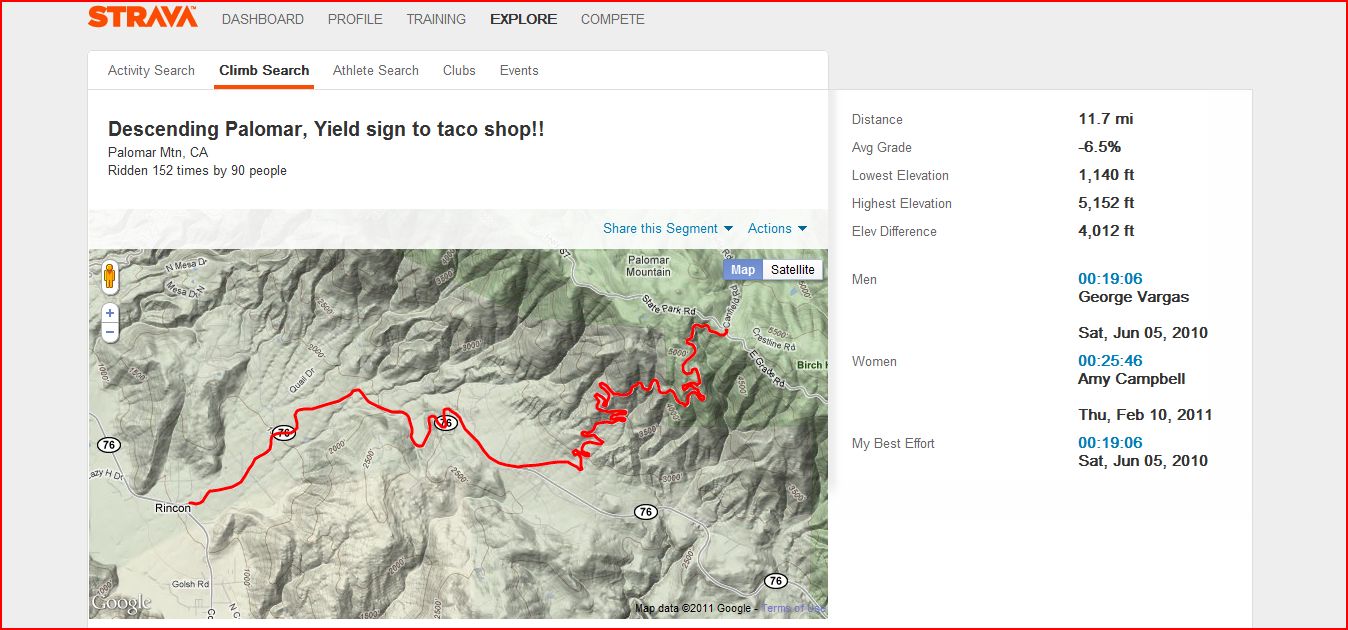

Here is a screenshot of the 11.7 mile descent of Palomar Mountain my average speed was 36.8 mph (technical descent)
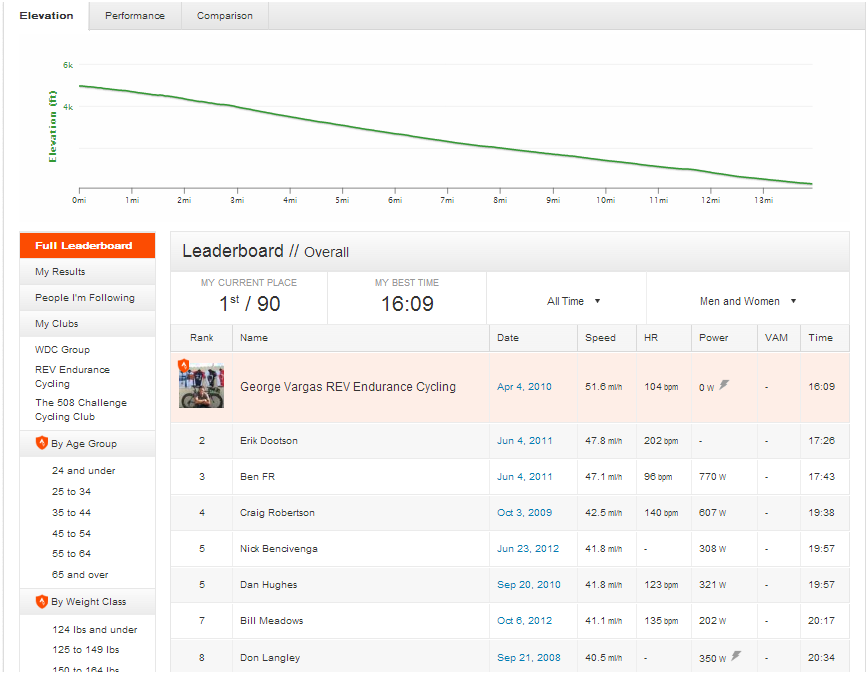
here is another one on Towne Pass 14 miles at 51.6 mph (not very technical and a tailwind)

My issue with KOD – king of descent is that many riders that do not possess the proper skills or have not been trained properly on how to descend on a mountain and are out there hopelessly competing and trying to beat the times of far more experienced riders. I believe there are many riders who have crashed or have gotten into hot water while descending a mountain while attempting to beat a Strava segment.
Another safety issue I have with Strava segments is when riders create a segment that goes through a traffic control, be it a stop sign or traffic signal. What the heck was that person thinking when they created that segment? NOT SMART! NOT SAFE! I have seen segments where the hill will crest (appropriate end of segment) but yet it goes past the traffic signal as the hill levels off and begins descending on the other side of the traffic signal. Why? That’s just freaking stupid and unsafe. I have flagged those segments and I hope that more of them are flagged by safety conscious riders.
One last comment on safety. As cyclists we are constantly whining for respect from motorists. Being a good safe cyclist also means being a good citizen. Earn that respect from motorists. Don’t ride your bike like an idiot because you are trying to get a KOM on a segment. Don’t run red lights or stop signs because some other idiot created a Strava segment that is 20 miles long and includes 10 traffic lights in it (yes those segments are out there). Be responsible, be courteous and above all be SAFE!
IMPROVEMENTS
I’d like to see where Strava has a bullshit filter. It should know if a hill is 7% grade that you can’t ride it at 50 mph. Many times I see segments where it’s obvious that a rider has forgotten to turn off his GPS unit and is now driving home setting KOM’s all around town at 50 mph. The software should be able to recognize that the segment is a hill and it isn’t possible to go up the hill at that speed. The software already recognizes the hill, and the percent grade now it just needs one more check before accepting the data and crowning a new KOM/QOM.
Here’s an off-the-wall request for a category – how about a tandem section? Doing a hill climb on a tandem bike is quite different from doing a hill climb on a solo bicycle. Why shouldn’t tandem bicycles be recognized for their hill climbing prowess? But I guess I can see where that can get complicated. You have male/male tandems or female/female and the most common – mixed tandems. And then where would it end triplets of quads? And what about recumbents and velo mobiles? And Eliptogo’s? Where does it end?
FINAL THOUGHTS
I commend Strava for what they’ve done. They’ve helped grow the personal GPS device market significantly, namely Garmin. They’ve gotten experienced riders, like myself, motivated to ride with renewed interest to revisit old climbs. Strava has also created a fun environment for new riders to challenge themselves while gaining insight on their capabilities and limitations as they compare themselves to seasoned riders. All in all Strava can be a positive thing. With the help of a coach and/or self-discipline Strava does not have to lead you into overtraining or injury. If you have an addictive personality then you need to be aware when too much is too much. Only you are responsible for your actions you don’t need Strava to train properly nor can you blame Strava for overtraining. Let us all be watchdogs and police ourselves and our friends to use it wisely, honorably and safely.
One of the ways I have found that I can use Strava in a positive way is by doing a time trial with my REV Cycling team. We can choose a hill and launch riders out with time gaps. All riders ride as hard as they can slower riders are launched out first and don’t want to get caught. Faster riders are launched with significant time gaps and have to work really hard to chase down the riders that were launched out ahead of them. When everyone is done the data is downloaded and you have an “official” inexpensive timing service!
Another option would be to settle an argument after a group ride on who actually WAS the fastest rider on a certain hill. On both of these uses you just click on the filter and choose “Today” then it Strava will show you only the results for that day.
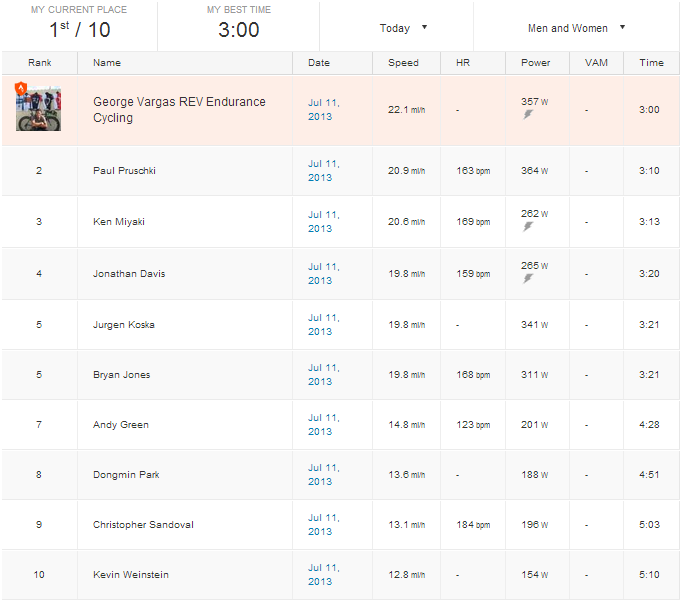
Does the cycling community need Strava? Maybe. Many of us will never pin on a race number and pay an entry fee to see how we measure up to other cyclists. But I think we are all curious…at least a little. Strava allows us to privately, and at our leisure, check our fitness and our capabilities. It allows us to connect with cyclists from around the world that share the same passion as we do. It is a social fitness website. Take what you need and enhance your riding experience with it but don’t become dependent or addicted to it.
I will leave you with a couple of links to Strava groups. The first is the REV Endurance Cycling group which a new development team/club focused on endurance events. The second is the 508 Challenge Cycling Club which encourages riders to ride 508 miles as part of living a healthy lifestyle. Join these clubs if you wish to be part of the Strava world. Whether Strava is for you or not don’t forget the key element in all this ….ride your bike it’s good for you!
Follow me on Facebook
Follow me on Twitter
Follow me on Strava
Follow me on SPOT
I’m very happy with my latest hard effort up Torrey Pines. I set a Personal Record of 6:03 It is a 1.45 mile hill with an average grade of 5.1% and gains 387 feet (your data may vary)
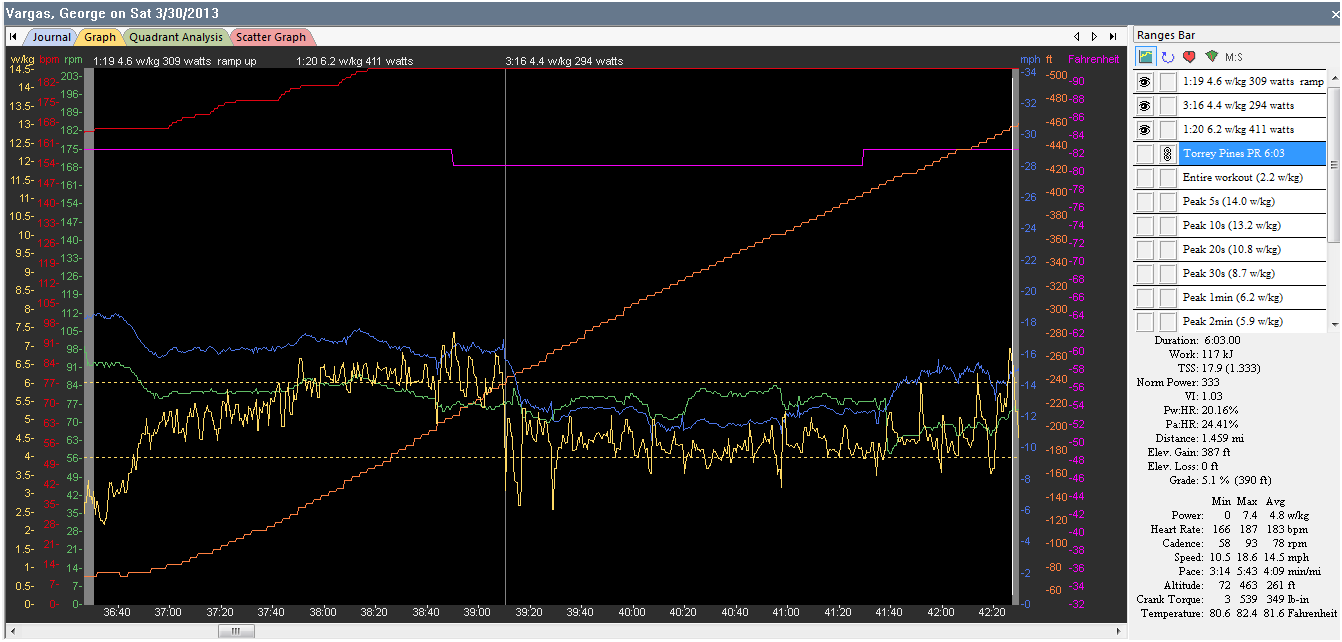
The first 1:19 seconds I ramped up the power to see how I felt. Avg wattage was 309 or 4.6 w/kg. I felt good so I surged on.
The next 1:20- Goal was to hold 6 w/kg actual 6.2 w/kg or 411 watts. I was trying to hold for 90 seconds but couldn’t. I just exploded. Next time I will try just 6 w/kg and see if I can make it 90 seconds.
Last section 3:16 – Goal was to hold over 4.5 w/kg actual 4.4 w/kg or 294 watts. I couldn’t squeak out 4.5 w/kg 😦
For the Heart Rate people out there notice that once reaches 187 bpm it remains pegged there regardless of my power output.
Average Speed was 14.5 mph
Normalized Power for the entire climb was 333 watts or 5 w/kg
My best 5 minute power was 342 watts or 5.21 w/kg
I guess my next goal would be to go sub 6 minutes!


Follow me on Facebook
Follow me on Twitter
Follow me on Strava
Follow me on SPOT

I had a great training ride on March 16, 2013. The St Paddy’s Palomar event has two options A. 68 miles with 6800 feet of gain B. 92 miles 8500 feet of gain but what does an ultra cyclist choose? Option C none of the above 131 miles with 11,600 feet of gain. I brought my REV Cycling teammate Lori Hoechlin, and met a few other endurance cyclists Jim Knight, Bob Bingham and Bob “Rock Lizard” Andrews at the Starbucks in Del Mar. We rode to and from the event and added a few extra miles. Lori had two slow leaking flats and probably worked harder than she needed to on such a long day. I had a great day on the bike. I had great legs and felt like I was holding back all day.
A quick word about the event. It was a fun time with more low key people showing up. No organized start just a steady rolling out of riders. Left to themselves riders know that a wave of 100 riders wouldn’t be safe 5 miles down the road as you climb Lake Wholford. You crossed your name off of a roster at the checkpoints and at the finish. Huge spread of pasta dishes salad and bread at the finish. I would do this event again! Thank you Jo and Rob of CCSD!
I used my SRM power meter to keep my power within preset ranges on all climbs. A power meter is ESSENTIAL for proper pacing in endurance cycling events. I felt great all day having paced my self properly. I am an authorized SRM dealer shoot me an email– revcycling@gmail.com if you wish to discuss purchasing an SRM Power Meter and pursuing a personalized power based training program from from me.
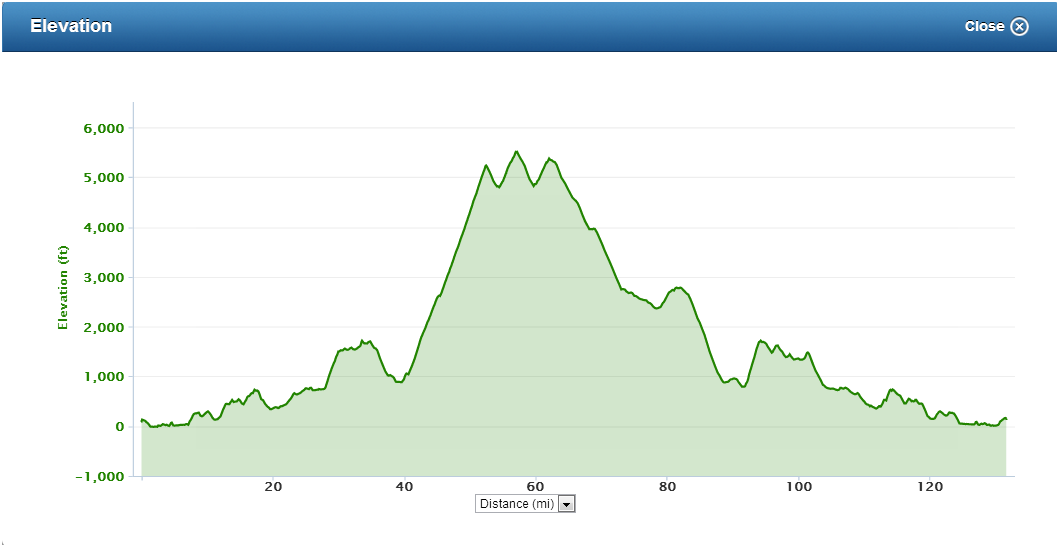

Calories burned 5,500 Calories consumed 2,100 calories in 10 hours
Below is a great shot taken of my by Mike Kurtz
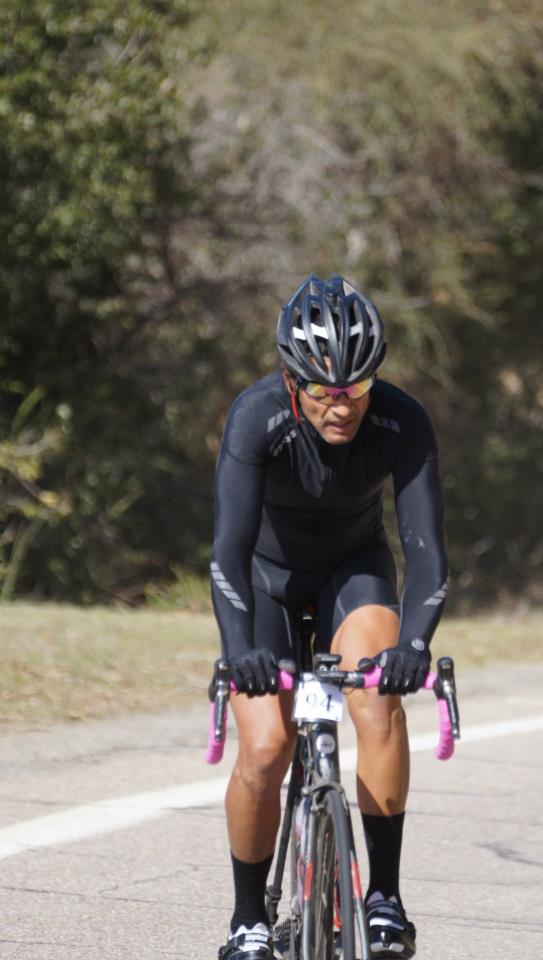
In this picture Skins CY400 compression cycling jersey bib shorts SPY Performance Pink Screws Swiftwick 7″wool socks Serfas Helix tires, Serfas Pro Series cycling gloves, Serfas pink bar tape and Suplest Supzero cycling shoes SRM Dura-Ace power meter and PowerControl 7 – thank you to all of REV Cycling sponsors!
This was also the longest ride in my new Suplest Supzero cycling shoes supplied by REV Cycling sponsor Serfas. I have a full product review coming soon. For now I’m putting in the miles and the hours. This was a long ride of over 130 miles with over 11,000 feet of climbing and lots of time in the saddle and my feet were quite comfortable. Shoot me an email with “Suplest Shoes” in your subject if you have any specific questions. Stay tuned for full product review on Suplest Supzero cycling shoes.
Below are screen shots from Garmin for the map and summary and screen shots from Training Peaks WKO 3.0.

Entire training ride

Lake Wholford great climb bottom half then ran into friend that was having gearing issues and paced her up a bit and then pulled over to adjust her rear derailleur.

Palomar Mountain Lower Section Goal maintain 3 – 3.5 w/kg

Palomar Mountain Upper Section- Goal maintain 3 – 3.5 w/kg

Cole Grade at 90 ish miles into our day I holding back and pacing my REV Cycling teammate Lori Hoechlin who was fading- she recovered nicely for the last 40 miles of the day. Goal maintain over 3.0 w/kg but had to hold back
Follow me on Facebook
Follow me on Twitter
Follow me on Strava
Follow me on SPOT
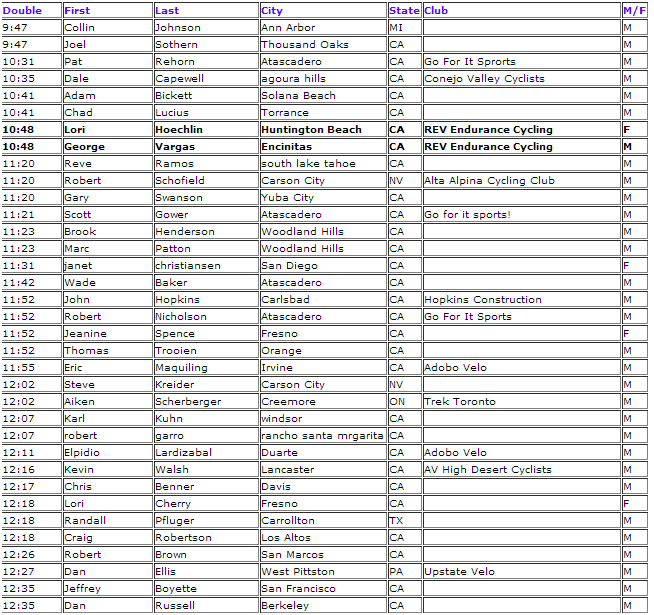
The official results for the 2013 Spring Death Valley Double Century are up! Follow this link for full results century, ultra and double century.
REV Cycling Team members
George Vargas 10:48
Lori Hoechlin 10:48– FIRST DOUBLE CENTURY ON SOLO BIKE
Krisztian Romvari 11:56– unofficial time currently listed as DNF on the official results
Amy Snyder 14:19
Brian Dooley 15:32– FIRST DOUBLE CENTURY
We congratulate and welcome Lori Hoechlin and Brian Dooley to the Double Century Club!!
Death Valley Double Century Results


Follow me on Facebook
Follow me on Twitter
Follow me on Strava
Follow me on SPOT
UPDATE 3/12/13 OFFICAL RESULTS HERE
On March 2, 2013 I completed the Spring Death Valley Double Century in an unofficial time and Personal Record of 10:48. This event was my season opener and the debut of my new endurance development team, REV Endurance Cycling. The Spring Double also came at the end of a glorious week of riding as a participant of the 2013 Death Valley CORPScamp. It was REV Cycling teammate Lori Hoechlin’s first Double Century (197 miles actual) and she performed like a rock star! It also represented the hard work and sacrifice I put in over the winter to loose 15 pounds, get fit and redeem myself from the poor ending of my 2012 season.
There were six members of REV Cycling at the event. I’m still waiting on their race reports. Once they are ready they will be posted here as well.
I wish to thank REV Cycling sponsors Spy Optics for their super cool sunglasses, Serfas for tires, tubes, bar tape, True 500 headlights and Thunderbolt Taillights and so many other things on my bike, Swiftwick for the great wool riding socks (yes wool socks in 88F temperatures) and their great compression recovery socks. Skins for their outstanding CY400 compression cycling clothing.
Now let’s get into this. Below you will see a summary from Garmin Connect of the week of Feb 25- March 2. Lori and I rode Monday – Thursday, rested Friday and raced the Double Century on Saturday. You will see from my CORPScamp write-up that on most of the days Lori and I opted for the longer routes with additional climbing. Some of these climbs were 20+ miles long.


RACE DAY Equipment- Cannondale SuperSix EVO with Shimano Di2 and satellite shifters on the aerobars, 7900 Standard 53/38 SRM Power Meter Crankset with a 11/28 cassette. Profile CSX carbon aerobars, Serfas True 500 headlights and Serfas Thunderbolt taillight.
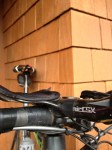
I like the Profile Design CSX for my ultras because I am quite flexible on the bike. Sadly I can’t touch my toes standing up and bent over when not on the bike lol. I don’t like the rise that most aerobars create above my normal handlebar position– usually too high.
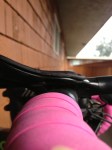
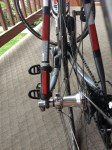
With the CSX I can install the aerobars without having to change my stem or stack height. Notice in the pictures below the height increase is fewer than 5mm. When using other aerobar setups I have to lower the handlebar to get back to the aero position I would have with just my forearms resting on the top of the handlebar. If I change the stem or stack height to accomodate my aero position then it compromises my normal saddle to bar drop in my non-aero position i.e. climbing.
I will be evaluating a different aerobar soon and will report back with my findings.
Below are pictures of my bike set-up



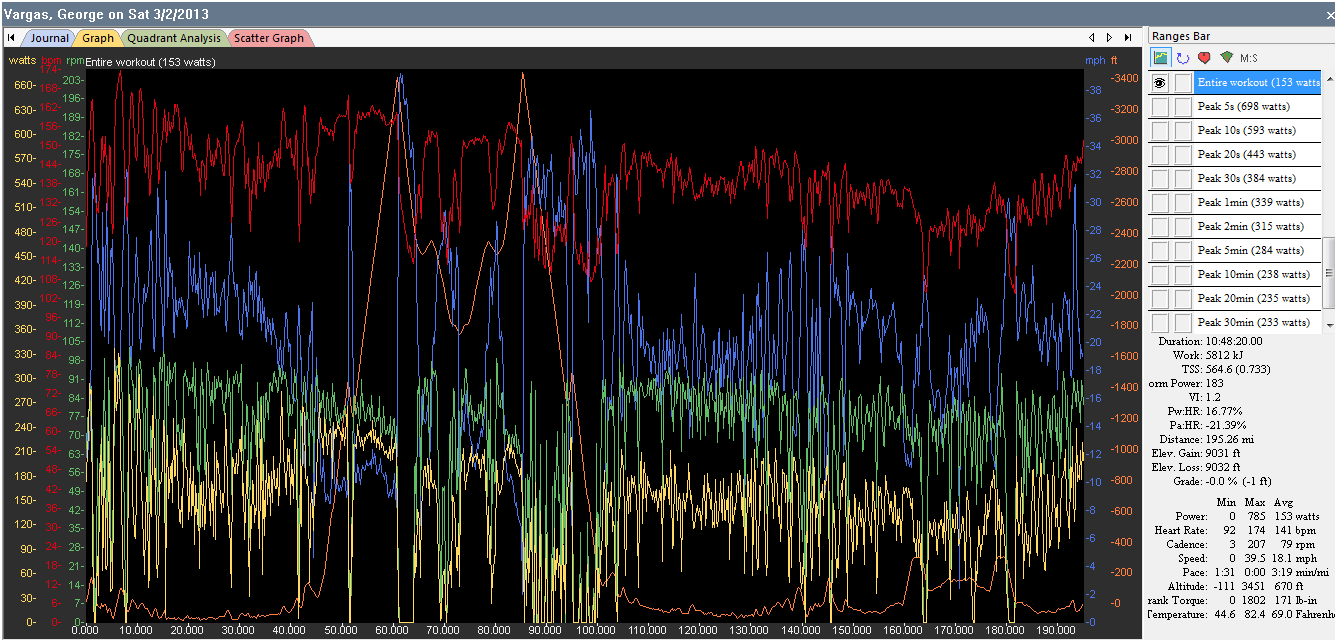
Quick summary
195 miles 9,000 feet of climbing.
10 hours 48 minutes
5800 kjs
Normalized Power 183 watts or 2.7 w/kg top end of endurance range
Furnace Creek to Badwater
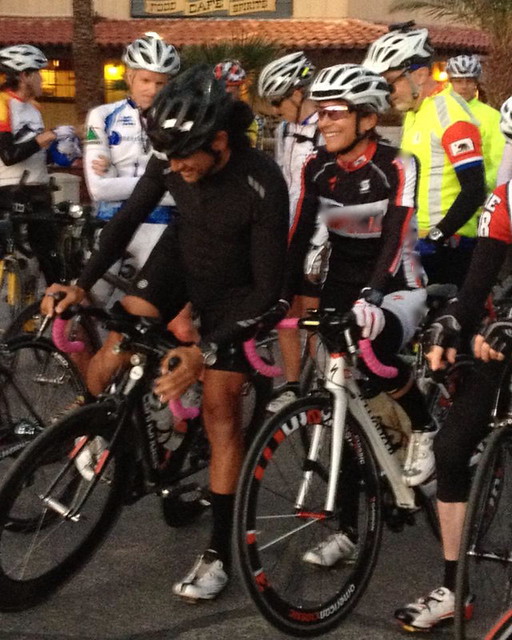
Lori and I rolled with the 6:10 wave. Right from the start there was a one mile slight uphill grade and you could feel everyone fighting for position. I knew the right people to mark. I didn’t panic during the constant reshuffling amongst the riders. I just sat-in close to the front. I tried to keep my teammate Lori Hoechlin on my wheel during those first few miles but I kept loosing her in the chaos. It’s difficult, if not unsafe, to keep turning around in a paceline to look for your teammate. Before the event I advised Lori how the first few miles would be and I impressed upon her that she had to stay on my wheel at all costs.
There are two schools of thought during these opening miles- one is to conserve energy since it is so early in the event, the other – work hard to get in the break. Let’s discuss option 1 first. If you don’t make the break but you are stronger than the second pack of riders you might have to sit-in for a long time before you can make your own move through the field. Meanwhile, the lead pack is moving at a higher rate of speed down the course. If you decide to leave the comfort of the second pack then you are fighting the wind, typically alone, until you can catch the lead pack— A LOT more energy expended using option 1.
Now let’s discuss option 2 – working hard to make the break may be less work in the end because typically once the break is established the lead group shares the workload to stay ahead of the main field and the pace isn’t as frantic. As a breakaway unit you are moving much faster than the main field (unlike pro cycling) but conserving a lot of energy.
Later in this report you will see that once the break was established my Normalized Power dropped significantly. Lori currently subscribes to option #1 while I subscribe to option #2. It would have been interesting for Lori to have had a power meter for this event so I could have tested my hypothesis. She did not make the break and consequently had to chase for 80 miles. I believe she exerted more energy to catch me than I exerted to be ahead of her in the first 80 miles.
Lori believes if she goes out hard she will blow-up and not finish strong. I shared with her my perspective. The bad thing about a double century is that it’s 200 miles and a lot of things can and sometimes do go wrong. The good thing about a double century is that it’s 200 miles and a lot of the things that can go wrong can right themselves because it is a long event. These are just some examples-
tired legs – ride easy and they come back
fatigue- ride easy and fuel up, recover and you come back
stomach issues- stop fueling, change fuel, ride easy, recover and you come back
getting lost- find your way back, let it go, regain focus, and you come back
overextertion early- ride easy, recover and ride your pace
Below is the screen shot of Training Peaks WkO+ 3.0 of Furnace Creek to Badwater. You will get an idea what are the power demands to get “into the early morning breakaway” I will also mention that if you wish to be competitive at these events you must concede that until the break is established and either you are in it or not YOUR race plan is on the back burner.  Some things to note:
1. I have the power band (yellow horizontal lines) for TEMPO pace which is from 209 watts to 249 watts or 3 w/kg to 3.7 w/kg. You will see that in those first 45 minutes I was well above tempo range just to stay in the lead pack.
2. About mile 5 there is a 5 minute segment where I am over 330 watts which is about 4.8 w/kg. It’s early in the season so I haven’t done any interval training yet. My goal event is the Furnace Creek 508 2X in October. I will be doing intervals August and September. If you intend to be part of the breakaway you may want to do intervals to be ready for these prolonged accelerations that could have you unhitched from the breakaway if you’re not trained for them.
3. I have placed another power line at 420 watts or 6.2 w/kg to show the number of surges. The highest surge was a spike of 785 watts or 11.5 w/kg. These surges can and will take their toll on you. It’s for this reason that Lori and others like her prefer to ride conservatively and avoid the breakaway in the opening miles of a double century.
4. Cadence line (green horizontal line) 95 Rpm (84 Rpm Actual)
5. Heart Rate (red line) 143 to 161 Bpm is Tempo range – you can see the variability in my heart rate as the break accelerates or when I take a pull. I watch my power to stay at 3.5 w/kg during my pulls. If you are a Heart Rate person that means I rolled off the front when I saw my HR nearing 160 Bpm
6. Pwr:HR ratio- less than 5% is good (4.89% actual)
7. Normalized Power was 222 watts or 3.3 w/kg
8. Elevation Gain- 552 feet
What all this data translates to you is that you must be prepared and trained for constant accelerations, high cadence and power spikes to close gaps and an elevated heart rate and riding outside of your comfort zone. Ultimately, you must be 100% committed to taking the risk that all this effort will result in you assuming a position in a small number of dedicated and highly skilled riders loyal to each other and willing to work together to stay away from the main field.
PASSING THROUGH BADWATER ELAPSED RACE TIME 47:32
Badwater to Ashford Mills
The lead group does not stop at Badwater which is only 17 miles into the event. I happened to rotate to the front just as we rolled by the Badwater turnout. It was awesome when the volunteers came to the road’s edge and cheered us on with cowbells and all. THANK YOU! Below is the screen shot of Training Peaks WkO+ 3.0 of Badwater to Ashford Mills. Now you can see the difference in the power demands once “the early morning breakaway” had been established. You will notice that the power demands are much lower. 1. I have the power band (yellow horizontal lines) for TEMPO pace 209 watts to 249 watts or 3 w/kg to 3.7 w/kg. Note that the power is well below TEMPO range. Now being in the breakaway I’m conserving energy and moving along at a rapid clip.
2. Power line at 420 watts or 6.2 w/kg– surges have been drastically reduced. There was a spike of 611 watts or 9 w/kg
3. Cadence line (green horizontal line) 95 Rpm (85 Rpm actual)
4. Heart Rate 143 to 161 Bpm is Tempo range heart rate is well within range now.
5. Pwr:HR ratio- was -8.8%
6. Normalized Power has come down from 222 watts in the first segment to 189 watts or 2.8 w/kg in this second segment.
7. Elevation Gain- 671 feet
ASHFORD MILLS ELAPSED RACE TIME 2:04:53
Ashford Mills SAG stop (1:49)- I refilled one bottle with 400 calories, went to the bathroom and remounted in fewer than 2 minutes.
The majority of the lead group stopped at Ashford Mills. A few riders did not stop and continued on to the 6.75 mile climb, Jubilee Pass. As the riders launched out from the SAG stop I found the pace too high for my liking. I looked down at my power and saw it way out of the range. I let those riders go up the road without me. I wanted to hold about 3.5 w/kg on the next two climbs (6.75 miles and 8.5 miles).
For me to do well in Ultras I need to maintain proper pacing, particularly on climbs. I don’t chase rabbits. I usually catch most of the rabbits either on the climb or miles and hours down the road as they start to fade. The SRM crankset power meter is ESSENTIAL to me for proper pacing. Please contact revcycling@gmail.com if you would like to purchase an SRM from an authorized dealer.
 Below is the power chart for the Jubilee climb. I have changed the chart to Watts per Kilogram because when climbing power to weight is most important. Also stating Watts per Kg (w/kg) makes everything comparable and all you have to do is insert your weight in kilograms and you will know what power you would be producing to stay with me or ahead of me.
  As we continued up the Jubilee climb I passed one rider. I slowed to pace him up the climb. My own pace slowed too much and after my third attempt to pace him I bid him farewell. I then caught and passed another cyclist. As I crested I caught a third cyclist and suggested that we work together.
As we began the Salisburry Climb I tried to pace this third rider up the climb with me. I slowed down three times for him but he just couldn’t stay on my wheel. I believe he went too hard on the Jubilee Climb.
Begin rant– One of the many reasons why I formed REV Cycling was I was sick and tired of working really hard to get in a break, work harmoniously with members from so many other teams, and then the group would completely disintegrate when we would hit the first climb of the day. This is EXACTLY what happened yet again at the Death Valley Double. Why does this happen? Why are people so focused on their own individual effort to save a minute here and there?
I can’t wait until the day that I have three or four strong riders from REV Cycling in the break controlling the pace of the break and take charge of pace setting up the climbs. Keeping at least HALF of the at 12 man breakaway together on the climb would have resulted in a much lower time for all of us. REV Cycling proved that teamwork works even at double centuries. With just two of us we worked through the field picking up stragglers and inviting them to roll with us. As the race ensued the lead group came together and split up multiple times throughout the day. We may not like Lance Armstrong now but you know deep inside you loved when the US Postal team would usher him up a climb with all eight teammates on the front of the field setting tempo. It was a show of force, unity and teamwork. I wish to bring that to the double century circuit with REV Cycling. End rant.

1. I have the power band (yellow horizontal lines) for TEMPO pace which is from 209 watts to 249 watts or 3 w/kg to 3.7 w/kg. Note I held the power well within the TEMPO range. I am following my race plan and I feel great on the first climb.
2. Power line huge spike as we pulled out of Ashford Mills SAG stop. One of the riders that dropped me at the beginning of this climb at mile 46 I caught later at mile 150. The other rider was Collin Johnson was tied for first by the end of the day.
4. Cadence average was 80 RPM
5. Heart Rate 155 to 160 Bpm is top end of Tempo range (161 Bpm is threshold)
6. Pwr:HR ratio- was -2.32 %
7. Normalized Power was 232 watts or 3.4 w/kg up from 189 watts or 2.8 w/kg of the paceline segment of Badwater to Ashford Mills.
8. Elevation Gain- 1415 feet
JUBILEE PASS ELAPSED RACE TIME 2:42:41
 Salisburry Climb
After a short one mile descent I began a 8.5 mile climb to the summit of Salisburry Pass at 3315. The one mile descent isn’t enough to fully recover but it does give your legs a little break. I settled-in again for a long climb. I was feeling great but keeping myself at bay.
1. I have the power band (yellow horizontal lines) for TEMPO pace which is from 209 watts to 249 watts or 3 w/kg to 3.7 w/kg. Note I held the power well within the TEMPO range. Still following my race plan and I feel great on the second climb.
2. Cadence average was 76 RPM I run a 53/38 as the grade steepens it becomes difficult to keep a high cadence and still keep the power where required.
5. Heart Rate 155 to 160 Bpm is top end of Tempo range (161 Bpm is threshold)
6. Pwr:HR ratio- was – -3.13 % (within 5% range is good)
7. Normalized Power was 221 watts or 3.25 w/kg down from the Jubilee Climb of 232 watts or 3.4 w/kg.
8. Elevation Gain- 2196 feet
SALISBURRY PASS ELAPSED RACE TIME 3:33:54
On the descent from Salisburry Pass to Shoshone I noticed Adam Bickett on the side of the road. He was gathering his things from his flat tire. I helped him get organized and then we rolled off. He confided in me that he was a little fatigued from his overnight ride up and over Towne Pass and back to start with the Double Century riders at 610am (100 miles). I decided to work with him through the little uphill section before the second descent towards Shoshone. We rolled into Shoshone together. I drank half a Pepsi, had a V8 and refilled two bottles while Adam did the same and topped off his flat with a floor pump. (Every SAG stop should have a floor pump.)
Shoshone SAG Stop 1:55
SHOSHONE SAG STOP ELAPSED RACE TIME 4:08:35
 Salisburry Climb #2
As Adam and I were approaching the left turn to reenter the Death Valley National Park I saw my REV Cycling teammate, Lori Hoechlin making her way to Shoshone with a male rider. I was impressed that she had closed the huge gap between us and was only 2 miles behind me. She was the first female on the course which made me smile ear to ear. I told Adam that we should slow our pace a bit, recover and wait for Lori because she is great little climber. Our pace slowed and we chatted most of the of the climb. About 2 miles from the summit Adam had recovered and just took off. I was more than ok with his surge because I know he is a stronger rider than me and I wouldn’t want to hold him back.
SALISBURRY PASS #2 ELAPSED RACE TIME 5:05:29
When I reached the summit of Salisburry Pass I pulled over and waited for Lori. I expected her to arrive within about 5 minutes. I knew that as a team what was more important was to work together for the next 120 miles. Lori arrived in fewer than 5 minutes 4:22 actually. I congratulated her on her solo climb and we headed down the next two descents (Salisburry to Jubilee and Jubilee to Ashford Mills). Lori is really lean and climbs well but that same attribute hinders her on descents. On many of our training rides this winter I would be coasting and she would need to pedal to stay on my wheel on descents.

The descent from Salisburry Pass back into Death Valley is an opportunity to catch up on your calories. In my opinion, keep your heart rate down and just cruise down the mountain and get at least one bottle back in you. Replacing the calories is very important because even though you have done the majority of the climbing for the event, it has been in a concentrated section (6,000 feet in 60 miles) and you still have another 120 miles left to ride in the event on the valley floor many times with heavy winds in the afternoon.

ASHFORD MILLS SAG STOP ELAPSED TIME 5:46:49
Ashford Mills SAG Stop #2 mile 103 2:01
I filled up two bottles with 400 calories each. Lori and I traded pulls until we arrived in Badwater. All the endurance paced miles during the winter training build-up were paying off. I usually fade in this section but I felt fine- just the usual fatigue of having ridden century plus miles in less than 6 hours.

BADWATER ON RETURN ELAPSED RACE TIME 7:14
Badwater SAG stop 1:07
When Lori and I pulled into Badwater, Adam said he had only arrived 2 minutes before us. He went on to admit that maybe he should have waited with me at the summit of Salisburry and worked with the Lori and I. Remember when he surged ahead the last 2 miles of the Salisburry pass at mile 87? Well here we were at mile 130ish together again. Lori and I riding were riding conservatively but steady and yet we still caught him.
We teamed-up to ride from Badwater to Stovepipe Wells. I couldn’t help but think that all three of us should have been clad in REV Cycling kits. I asked Adam to join REV Cycling back in December when I first formed the team. He declined but it was nice to be sharing pulls with a him on this day nonetheless.

I make it a habit of not stopping at Furnace Creek mile 150ish because I have just made a stop 17 miles ago. Many riders stop and then get sucked into the vortex and call it a day at 150ish. As Lori, Adam and I rolled through Furnace Creek we picked another rider, Chad. He was doing his first double century and was feeling the effects of his hard efforts earlier in the day. He confided in me that he had to eat solid foods at Badwater and Furnace Creek to start recovering. I hadn’t eaten anything at all during the event and finished without eating any solid foods. I never felt hungry I just kept the calories coming in on a continuous basis.
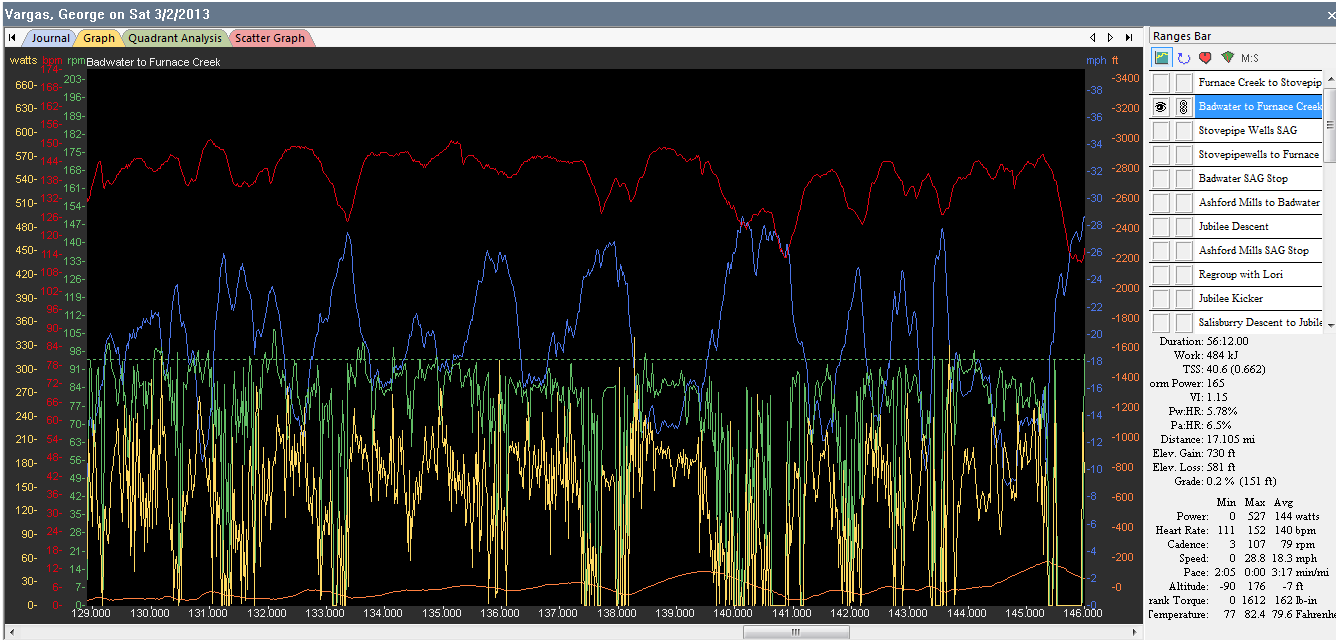
FURNACE CREEK START/FINISH LINE MILE 147 ELAPSED RACE TIME 8:11:42
Now we were four strong riders heading towards Stovepipe Wells- Chad, Lori, Adam and myself. It was 8 hours and 11 minutes elapsed time when we rolled by Furnace Creek. The first thoughts going sub 11 hours began to brew in my head. All we had to do is 50 miles in less than three hours…just a little over 16 mph average. But it’s not as easy as it sounds since we are 150 miles into the event already with a blistering time. How long can we keep this up?
The four of us traded pulls and seemed to be working well as a unit until about 10 miles from Stovepipe Wells. There is a roller about mile long. Adam and Chad rolled away from Lori and I. I was comfortable with the pace Lori and I were maintaining and so I didn’t want to push any harder.

Stovepipe Wells SAG stop 4:18
STOVEPIPE WELLS SAG STOP ELAPSED RACE TIME MILE 170 9:36
We arrived at Stovepipe Wells while Adam and Chad were still getting organized and refueled. When they were ready to roll they ask us if we wanted to leave but I declined. I wanted to take an extra minute to prepare for the final 25 miles. Stovepipe Wells was our longest SAG stop of the day. I filled both bottles with ice and a weaker dose of Perpetuem since we were heading back to the finish and I wanted a lighter taste. By this point I was done drinking Perpetuem. I really dislike the flavor and the bloating it causes me to bear.
To cleanse my palate I drank half a Coke and start feeling normal again. I also asked my friend Steve Barnes to put ice down my back. I wasn’t hot but I just wanted to “snap out of it”. He remembered the trick from the year he crewed for me at my 2010 5th consecutive solo Furnace Creek 508.

2010 Furnace Creek 508 5th solo. Outside of Baker day 2
Stovepipe Wells to Furnace Creek
I was feeling fatigued and Lori seemed to be feeling strong. So as we traded pulls I let her take longer pulls until I could recover. I was impressed by her endurance in her first double. I was content with our position in the overall standings and also that Lori was the first female on the course. She was not in jeopardy of loosing that position since we were on the final leg of the double and there were no females in sight. When I told her that our race plan had gone just perfect she looked at her watch and threw me another challenge.
My original race plan for us was sub 12 hours. I know how easily the winds and heat can come through the valley and make it really tough on us. But Mother Nature was kind to us today and we were on record pace – my personal record. My fastest time on the southern route was 11:07. Lori then said to me “we can make sub- 11 hours” I then began counting down the miles and recalculating. When we crested one of the last long rollers and made the right turn towards Furnace Creek I saw the very familiar sign from all my previous Furnace Creek 508’s “Furnace Creek 17” We had an hour to ride 17 miles. Usually that’s not a problem but with 180 miles on your legs it can be a task.
Below is the graph of the last 17 miles. Lori and I covered this segment in 46 minutes with and average speed of almost 22 mph! Great teamwork Lori! REV Endurance Cycling provides an example that teamwork is essential in long distance events. Come join America’s only ultra cyclist development team. Send an email to revcycling@gmail.com


Normalized power for the final 25 miles was down to 150 watts! I was fading through most of the final stage but finished strong in the end. Mentally I had also shut down knowing I was not going to gain or loose any positions in the last 25 miles.
Summary of all stops
Ashford Mills SAG stop (1:49)- I refilled one bottle with 400 calories, went to the bathroom and remounted in fewer than 2 minutes.
Shoshone SAG Stop 1:55
Ashford Mills SAG Stop #2 mile 103 2:01
Badwater SAG stop 1:07
Stovepipe Wells SAG stop 4:18
Summary of times at checkpoints
PASSING THROUGH BADWATER ELAPSED RACE TIME 47:32 – Mile 17
ASHFORD MILLS ELAPSED RACE TIME 2:04:53- Mile 45.5
JUBILEE PASS ELAPSED RACE TIME 2:42:41
SALISBURRY PASS ELAPSED RACE TIME 3:33:54
SHOSHONE SAG STOP ELAPSED RACE TIME 4:08:35 – Mile 74
SALISBURRY PASS #2 ELAPSED RACE TIME 5:05:29
ASHFORD MILLS SAG STOP ELAPSED TIME 5:46:49 – Mile 103
BADWATER ON RETURN ELAPSED RACE TIME 7:14- Mile 130
FURNACE CREEK START/FINISH LINE MILE 147 ELAPSED RACE TIME 8:11:42- Mile 147
STOVEPIPE WELLS SAG STOP ELAPSED RACE TIME 9:36 – Mile 170
FURNACE CREEK FINISH LINE ELAPSED TIME 10:48 (UNOFFICIAL TIME)
I wish to thank Chris Kostman of AdventureCORPS for putting on another fantastic event with great support. Thank you to all the great volunteers who gave of their time so that I could ride my bike.
Please look at other events held by AdventureCORPS. The Mount Laguna Bicycle Classic is one of my favorite climbing events. I have done it every year since it’s inception and will be there again this year. REV Cycling will have a series of pre-rides out in the area to get our team members familiar with the course. Come join the training rides and register for a great event with no traffic to speak of and lots of climbing and scenery to take in!
Also remember that REV Cycling official charity is the Breast Cancer Research Foundation. REV Cycling founder, George Vargas, lost his mother to advanced and aggressive breast cancer. He is driving his team through a month long charity raising campaign — March Madness. His donation page can be found here. REV Cycling will be making a custom run of REV Cycling T-Shirts co-branded with the Breast Cancer Research Foundation. A portion of each purchase will be donated to the Breast Cancer Research Foundation.
Below are the Hoodies, T-shirts and track jackets available for sale through REV Cycling with donations for Breast Cancer Research Foundation. Please send an email to revcycling@gmail.com to place orders.


Follow me on Facebook
Follow me on Twitter
Follow me on Strava
Follow me on SPOT
Hello everyone I have spent a fantastic week cycling at the 2013 Death Valley CORPScamp. I wish to thank REV Cycling sponsors Spy Optics for their super cool sunglasses, Serfas for tires, tubes, bar tape and so many things on my bike, Swiftwick for the great wool riding socks (yes wool in 75F temperatures) and great compression recovery socks.
Now I wish to highlight the top 10 reasons why you NEED to put this cycling camp on your itinerary for 2014.
Here are just a few pictures of the camp. Click here to see more. A week long of moderate temps and blue skies every day!


But don’t fret if you missed this camp. You still have another chance to experience AdventureCORPS phenomenal customer service and a first-rate cycling camp experience. CORPScamp’s new sister camp, Velo & Vino is coming up April 15-19. It is held in the beautiful mountains east of San Diego with a homebase out of Julian.
Ok now the data geek in you can geek out over the next section of this blog post :-p
First the summaries


Day 1

The first ride of the camp is held on Monday afternoon. Check-in is between 1130 and 1230 and the ride is scheduled for 115pm after the Dynamic Warm-up held at 1pm. It is the perfect ride of 25 miles to ensure your bike is in good running order and to spin out your legs from traveling into Death Valley. Artist Drive is quite steep so bring your climbing gears. Compact cranksets or triple cranksets and large range cassettes will make this climb more fun. There are pitches of 12% so be prepared. The hard work is worth it as you arrive at Artist Palate. Also a common misconception is that Death Valley is flat. It is far from flat with continuous rolling terrain to and from Artist Drive. Ride stats- 25 miles 2,600 feet of gain.
Day 2

On day 2 you have several options for your ride because it is a true out and back course. From Furnace Creek to Stovepipe Wells would be 50 miles round trip, you can continue to climb up Towne Pass to Wildrose Road and turn around or the big ride of the day takes you to Emigrant Pass. I would recommend taking on the climb to Emigrant Pass at least the first couple of miles so you can experience a climb many people don’t know about. Additionally, this climb is not on any of the AdventureCORPS events. Emigrant Pass is 5318 feet above sea level Remember when calculating feet gained on the climbs you must also factor in that you begin your climb from below sea level. Ride stats 95 miles 7,200 feet of gain.
Day 3
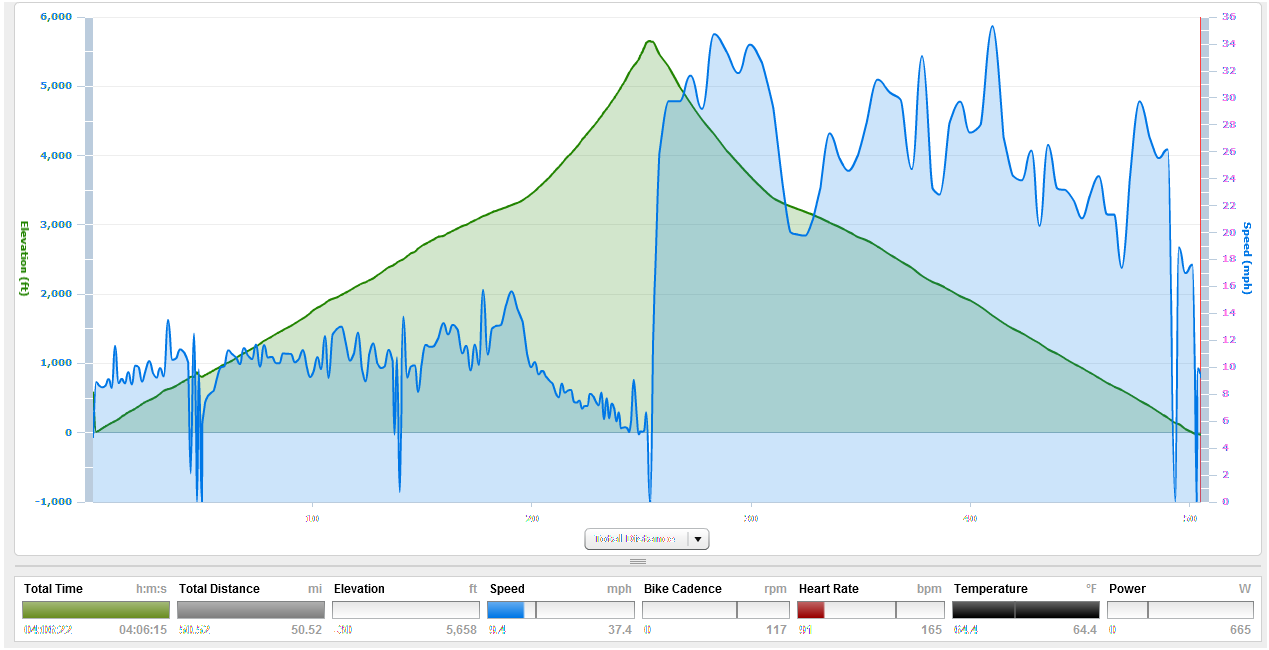
I opted for the climb up to Dante’s View. It is very difficult climb off the main road, Hwy 190, but the view from above Death Valley is spectacular. Bring your climbing gears because this is one steep bugger about five miles from the summit this climb averages over 8%. The last mile is over 10% and the last 1/4 mile is over 15% grade. Not a big deal usually right? Well it comes after you have been climbing for 25 miles! Ride stats 50 miles 6,000 feet of gain.
Day 4

I opted for the additional six miles past the designated route turnaround point of Hell’s Gate. A long 12.8 mile climb with over 4,000 feet of gain to Daylight Pass via Mud Canyon. Ride stats 58 miles 5,200 feet of gain.
The routes I opted for are not on the designated routes. I am an experienced ultra cyclist who has ridden many times in Death Valley in addition to many unsupported events. If you choose to go off of the designated routes take a buddy and tell everyone where you are going.
I wish to thank REV Cycling sponsors Spy Optics for their super cool sunglasses, Serfas for tires, tubes, bar tape and so many things on my bike, Swiftwick for the great wool riding socks (yes wool in 75F temperatures) and great recovery socks.
Death Valley is one of the most scenic places to ride your bike. Please consider AdeventureCORPS CORPScamps as a true cycling vacation option- and please tell them you heard it from me!


 George's Epic Adventures