20 min peak power on my commute this morning…


^^SCREEN SHOT JUNE 11, 2009^^

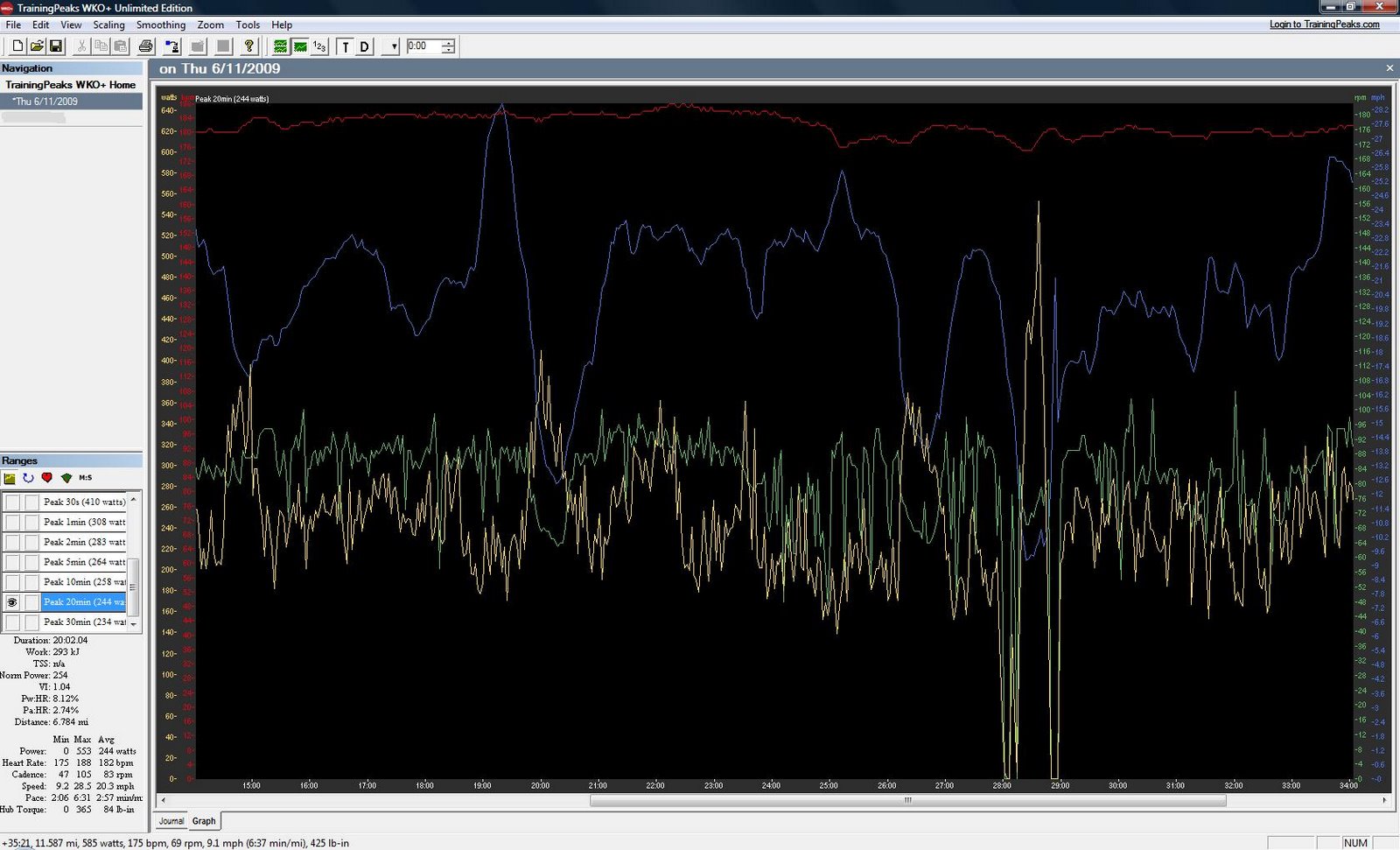
20 minute Peak Power from my morning commute. Weight 152 lbs or 69 kg

Average Power 244 watts / 69 kg 3.53 w/kg

Normalized Power 254 watts / 69 kg 3.68 w/kg

Look at my wattage from last night’s commute. What I would like for you to notice is that my Average Power was up a whopping 24 watts but my Normalized Power was only up 5 watts from 249 to 254 watts. Why is that?

Let’s look at Normalized Power :

TrainingPeaks uses a special algorithm to calculate an adjusted or normalized power for each ride or segment of a ride (longer than 30 seconds) that you analyze. This algorithm is somewhat complicated, but importantly it incorporates two key pieces of information: 1) the physiological responses to rapid changes in exercise intensity are not instantaneous, but follow a predictable time course, and 2) many critical physiological responses (e.g., glycogen utilization, lactate production, stress hormone levels) are curvilinearly, rather than linearly, related to exercise intensity, By taking these factors into account, normalized power provides a better measure of the true physiological demands of a given training session – in essence, it is an estimate of the power that you could have maintained for the same physiological “cost” if your power output had been perfectly constant (e.g., as on a stationary cycle ergometer), rather than variable. Keeping track of normalized power is therefore a more accurate way of quantifying the actual intensity of training sessions, or even races.

Source

In other words, when you apply power to the pedals it takes time for your body to react and when it does it reacts on a curve not in a straight line. Normalized Power takes this into account.

Or like my friend Sushi Joe says it “NP = the power you could have put out if you kept the effort as steady as possible. “

So back to my ride from last night. Notice how the POWER line is more erratic with rollers and traffic signals.

^^SCREEN SHOT JUNE 10, 2009^^

Compare it to this morning’s ride was not as variable the power was more consistent so the Normalized Power only increased by 5 watts from 249 watts to 254 watts.

20 minute number from my commute


On my commute tonight I did a 20 minute interval. My weight was 152lbs or 69 kg

Here is a screen shot from Training Peaks.

Power: YELLOW
Heart Rate: RED
Speed: BLUE
Cadence: GREEN

My Average Power was 221 watts / 69 kg = 3.20 w/kg
My Normalized Power was 249 watts / 69 kg = 3.60 w/kg

I felt good during the interval but after it I was spent for nearly 10 minutes. The interval was through a section that had traffic signals and a couple of rollers hence the spikes in power.

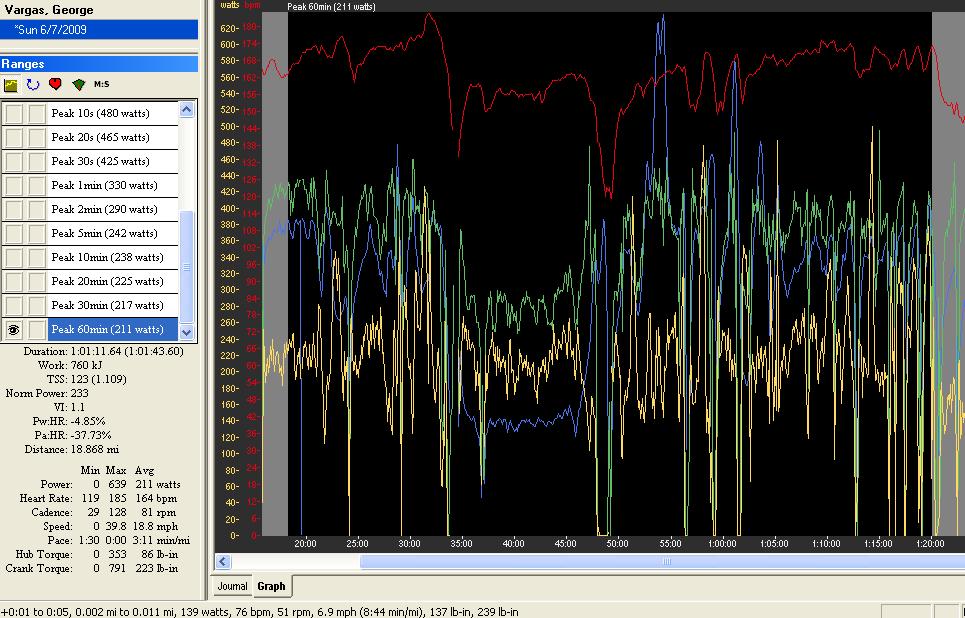
60 min Peak Power Number


Screen shot from Training Peaks.

Yellow- Watts
Red – Heart Rate
Green – Cadence

I only had 1.5 hours to ride this morning. I did a 25 mile loop that took me on fairly flat terrain before and after a 1.5 mile hill (Newport Coast Dr) that gains 472 feet with an average grade of 6% grade. After the crest there is a 5.2 mile (San Joaquin Hills) rolling descent. It requires a lot of work to keep the watts up on the descent which in the end hurts your 60 minute number. But it’s a good little game to play trying to keep the power up on the descent.

My Normalized Power was 233 watts for 60 mins. My weight was 150lb or 68.04 kg.

233/68.04 = 3.42

My 60 min peak number was 3.42 w/kg.

Average Power was 211 watts

211/68.04= 3.10 w/kg

Based on the Power Profile Chart that is right between the top range of Cat 4 (3.38 w/kg) and the low range (3.47 w/kg) of Cat 3.

New 30 sec Peak Power Number


I have a little competition going with my friend in Omaha, Nebraska SushiJoe.

Last night on my commute I asked him what his 30 second and 1 minute numbers were in absolute wattage and w/kg. I needed a carrot. I needed something to motivate me because the headwinds were demoralizing me. Have I mentioned how much I hate headwinds? I beat his 30 second number in absolute watts and in watts per kg (w/kg)as well. When reading power data it is important to not focus on the absolute numbers so much.

Here is an example. Two cyclists are comparing their wattage output on a local hill of 1.5 miles 6% grade.

John says: “I can hold 275 watts on that climb”

Mary says: “Really? I can only hold 225 watts on that climb”

Who is the stronger cyclist on this climb? Let’s take a look at body weights for these two riders.

John weighs 165 lbs or 78.84 kg

Mary weighs 125 lbs or 56.70 kg

So John’s w/kg is 275 watts divided by 78.84 kg = 3.67 w/kg

Mary’s w/g is 225 watts divided by 56.70 kg = 3.96 w/kg

On this particular climb, based on their weight and power output, Mary is the stronger cyclist because her w/kg for this climb is 3.96 w/kg.

An important concept to remember is that w/kg is a power to weight ratio. As you lose or gain weight your w/kg will change that seems obvious right? But far too many people try to buy their way into better climbing. If you want to improve your climbing lose weight. Typically you will continue to hold your absolute wattage output if you are shedding fat pounds and retaining lean muscle.

Above is a screen shot from Training Peaks. You will see on the left a small frame that shows a time frame and corresponding wattage. The only thing missing to make the data quantifiable is my weight. I weighed 150 lbs yesterday which is 68.04 kg.

My 30 sec peak power was 721 watts or 10.6 w/kg Sushijoe’s number was 7.91 w/kg. Ok Sushijoe there is your carrot. You have to beat 10.6 w/kg.

Being an Ultra cyclist, I am a slow twitch type of rider. I rarely do group rides. It is especially important for me to work on my fast twitch muscle so as not to lose that snap in my legs.